

Reading Bruno Baketarić Fixed the One Kanban Problem I Never Solved in Decades
Why I stopped mapping activities and started naming states

Value stream mapping breaks on creative work because the route is never linear
The bucket column problem that no amount of extra columns ever fixed
Bruno Baketarić’s state-space reframe: name the condition, not the activity
What his idea unlocked for art co-development and client-owned flow
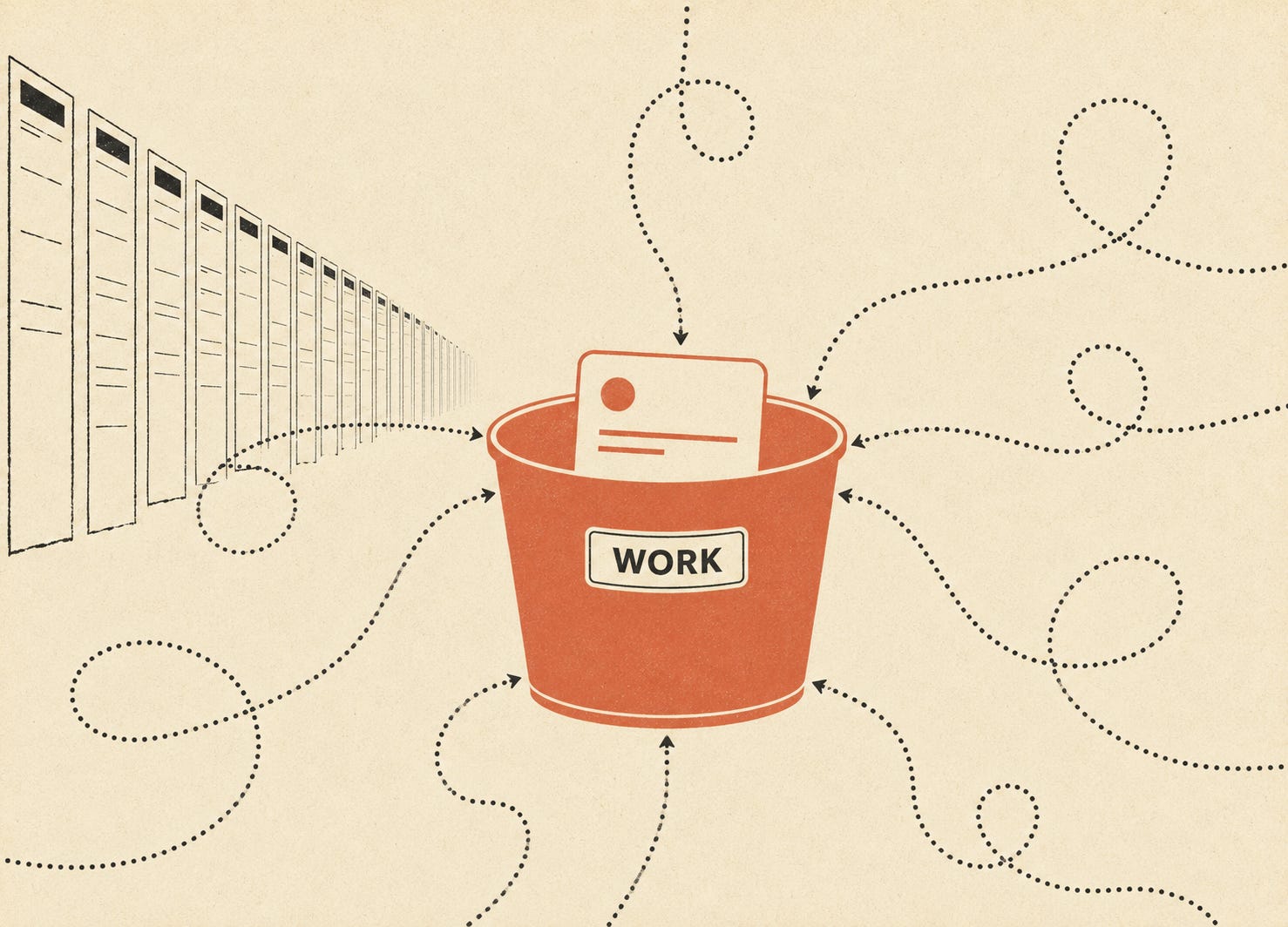
Here is a scene I have played out more times than I would like to count. I am at a whiteboard with a marker, mapping a creative pipeline for a team, and I am doing value stream mapping on work that will not hold a line. Concept, model, texture, rig, review. It looks clean on the wall. Then I present it, and within about four minutes somebody in the room finds the asset that skipped three of those stages, or the one that looped back into concept after texturing, or the one that was in review and development at the same time. And the fix, every single time, was the same fix. Another column. Another queue state. Another lane.
I have thirty years in game production and I kept reaching for the same tool to solve a problem the tool was built to create.
If this is useful, there's more where it came from. Multiple free posts a week on game production, applied AI, leadership and how the sausage actually gets made.
The board always grew. It grew to chase a process that has no fixed process. Creative work bounces around by nature: the route is discovered in the doing, and the path of the next asset cannot be read off the last one. I knew that. I would say it out loud in the very session where I was drawing a fixed left-to-right sequence on the wall and pretending it described the work. The contradiction did not register, because I had been trained, like most of us, to see a board as a picture of the steps.
The frustrating part is that I was not doing anything unusual. Column sprawl is a documented anti-pattern. The advice you will find everywhere is that teams inflate their boards with columns like Analysis, Testing, Approval, and Waiting on Feedback until flow goes sluggish, and that once you pass ten or so states the card metaphor starts to fall apart entirely. I was living inside that failure mode and I thought the problem was discipline. If I just mapped harder, interviewed the team more carefully, found the true sequence, the board would settle. It never settled, because there was no true sequence to find.
I want to be fair to myself here, because I did not stand still. I spent decades attempting value stream mapping on knowledge work and getting nowhere useful with it. Then I read Karen Martin and Mike Osterling’s Value Stream Mapping, the first book I found that was written for service and office work rather than the factory floor, and it was a real step forward. Later I adopted the flavour in Flow Engineering by Steve Pereira and Andrew Davis soon after it came out in 2024, which took the practice further still: lightweight, iterative, built for collaborative mapping conversations rather than a static diagram. Two genuine upgrades, each moving me further from the crude version, each honest that knowledge work is messier than a production line.
Here is the thing neither book could fix, because it sits one level below both of them. However modern the mapping gets, it is still mapping the flow as a route. It still lays the work out as a stream with a direction, and it never questions the one assumption underneath all of it: that the work has a shared path worth drawing. Even the friendliest advocates admit that when a process involves creativity, judgment calls, or heavy variability, a static map oversimplifies to the point of being misleading. For creative work there is no shared path. The map was always wrong the moment I finished drawing it, and a better mapping method could not save it, because the problem was in the shape of the tool, not the quality of the map.
So the frustration had two layers. I was applying a route-shaped tool to work that has no shared route, and I was blaming myself for the tool not settling.
The reframe I did not have a word for
The fix came from reading, of all things, a run of essays on Medium by Bruno Baketarić, who works on flow at SAP and writes about Kanban with more care than almost anyone I have read on the subject. I want to be precise about what he did to my thinking, because it was not a technique and it was not a template. It was one distinction, stated cleanly, that reorganised a problem I had been carrying around for decades.
The foundational piece is called The Board Is a State Space. The claim at its centre is this: a Kanban board models the state space of the work items, not the action space of the people working on them. A state is a condition the work item is in. An activity is something a person does. They are different kinds of thing, and putting the second one on the board is a category error that no amount of practice discipline can clean up, because the error is baked into the model.
A state is a property of the work item. An action is something a person does. The two are not the same kind of thing, and confusing them produces exactly the dysfunctions this essay is about.
Read that and then look again at every board I ever drew. My columns were activities. Concept is not a state, it is what a concept artist does for a living. Texturing is not a state, it is a job. I had built board after board out of the wrong unit, and then I had spent years patching the consequences.
Thirty-plus years of production work went into this. Most of it didn’t make the post. New posts every week. Free to read, free to subscribe.
A second essay, The Flow in Workflow, takes the argument down to the word itself. Workflow is work and flow, and flow, on the tradition’s own definition, is the movement of work through a system. So a workflow is the structure through which work moves: a space of states, with the transitions between them. The activities are the labour that carries an item from one state to the next, and they matter, but they are not the workflow. That is why the same field defines flow in terms of items and then, a paragraph later, defines workflow as a series of activities, and never notices the switch. I had inherited the switch and never noticed it either.
Why it dissolved the problem instead of solving it
Here is the mechanism, and it is the thing I wish someone had told me in 2005.
When your columns name activities, every new way of working needs a new column. You are modelling what people do, and people keep doing new things, so the board has to keep growing to keep up. That is the treadmill. That is why the edge case in the room always cost me a column. The asset that looped, the asset that skipped a stage, the asset worked in parallel: each one was a new action pattern, and an action-based board has to represent each new pattern with new structure.
When your columns name states, varying routes share one space. An asset in a given state has told you what is true of it, and it does not matter which of fifteen different paths it took to get there. The loop, the skip, the parallel work, all of it happens inside the states, and the states do not multiply, because a condition like “in production” or “awaiting review” holds true regardless of the sequence that produced it. The edge case that used to cost me a column now just traces its own path through states that already exist.
I was modelling the action space. That is why the board never stopped growing.
The same reframe quietly killed a second argument I had refereed a hundred times: the backflow fight. You know the one. Development calls something done, QA finds a problem, the card goes “back” to development, and the team spends the standup arguing whose fault the backward move was. Baketarić’s answer is that there is no backward move, because the item never left its state. If a finding surfaces in verification, that finding is information produced in the verification state, and the item stays in verification while somebody acts on it, even if acting on it means writing more code. State transitions go forward, or the item leaves the flow entirely. Nothing moves back, because the previous states no longer exist for that item. Once I saw that, an entire genre of team conflict I had learned to manage turned out to be an artefact of a mislabelled board.
The essay that explained my specific pain
There is a third piece in the run, The Family the Board Assumes, and it named the exact thing that had been happening to me for as long as I had been drawing these boards.
Value stream mapping works on a factory floor because every product in a family shares a route: press, then weld, then paint, same stations in the same order for every part. The order of activities is a faithful portrait of the work because the work is a fixed order. That shared route is a precondition, and on the factory floor it is so obviously met that nobody writes it down. When the technique crossed into knowledge work, the shape came along and the precondition got left behind. Creative work forms no families. Each asset finds its own path, so there is no shared route for the columns to portray.
That is my whiteboard, explained. I had been mapping design-flow work with route-shaped instruments for a long time, and feeling the precise pain of a missing precondition without ever being able to name it. Better mapping methods, Martin and Osterling then Flow Engineering, moved me along the surface of the problem without ever reaching the floor of it. The tool was not failing me. I was asking a route to describe work that has no shared route, which is a thing no mapping method can be scoped to fix.
What the reframe unlocked
The satisfying part is that this did not just retire an old irritation. It opened up something new in the work I do now.
I run production for a co-development studio, which means my teams make assets that flow into someone else’s pipeline, on someone else’s approval, on someone else’s timeline. Once I stopped carving boards by activity and started carving them by the condition the asset is in, a distinction fell out that I had never been able to see before: the difference between the time my team controls and the time the client controls.
On an activity board, a client’s three-week wait for a licensing sign-off is buried inside whatever column the card happened to be sitting in, and it quietly drags down every metric I report. On a state board, I can make “awaiting client review” its own state, sitting right next to the states my team owns. Now the flow data splits cleanly. Here is the time we held. Here is the time they held. For a service business that runs on trust and renewal, that split is not a reporting nicety. It is the argument I make in the quarterly review when delivery slipped and it was not my team’s doing.
The state framing also sat neatly on top of a position I had already held for years. I used to run Blocked columns like everyone else, until Daniel Vacanti’s When Will It Be Done? sent me down the flow-metrics rabbit hole, and I came out the other side convinced they were a mistake. A Blocked column is its own well-known anti-pattern: it lets cards drift sideways and quietly inflates your work-in-progress limits. I have argued against them in almost every studio I have worked in since, and I have long preferred a tag. Blocked is a flag on the card, timestamped in place, and the asset never moves. It stays in the state it is genuinely in, carrying a marker that says what it is waiting on, and your data separates active time from waiting time without anyone editing a clock. What the state-space reframe did was explain why the tag was right all along. A block is a condition, not a place, so it was never a column to begin with.
None of the co-development material was in Baketarić’s essays. His work is about a single team’s internal board. The client-owned split, the application to art co-development, those are mine, built on top of his frame. And the blocked-as-tag habit I brought with me from Vacanti. Which is rather the point. A good idea is generative. It does not just fix the thing the author aimed it at. It hands you a unit to think with, and it clicks into the things you already believed and shows you why they were right.
An old dog, a new trick
I have been doing this a long time, and I do not change how I work very often, because most of what gets sold as a new method is an old method with new vocabulary. This was different. Three careful essays gave a precise name to a thing I had been fumbling at for most of my career, and the name did real work: it dissolved a frustration, retired a recurring team fight, and opened a way to run a co-development board that I could not have designed the week before.
If you build boards for creative work and you have felt that same treadmill, the columns multiplying to chase a process that never holds still, go and read Baketarić’s essays. Start with the state space one. I have been at this since before some of my producers were born, and he taught me something. That is worth saying out loud.
If this changed how you think about even one thing, the next post might too.