


How Rockstar’s October 2025 mass firing triggered the opposite of its intended effect
Why the Rockstar Game Workers Union launched five months before GTA 6’s ship date
What a confirmed full employment tribunal hearing means for a studio in final production
The production risk hiding inside every labour story the industry is treating as HR news
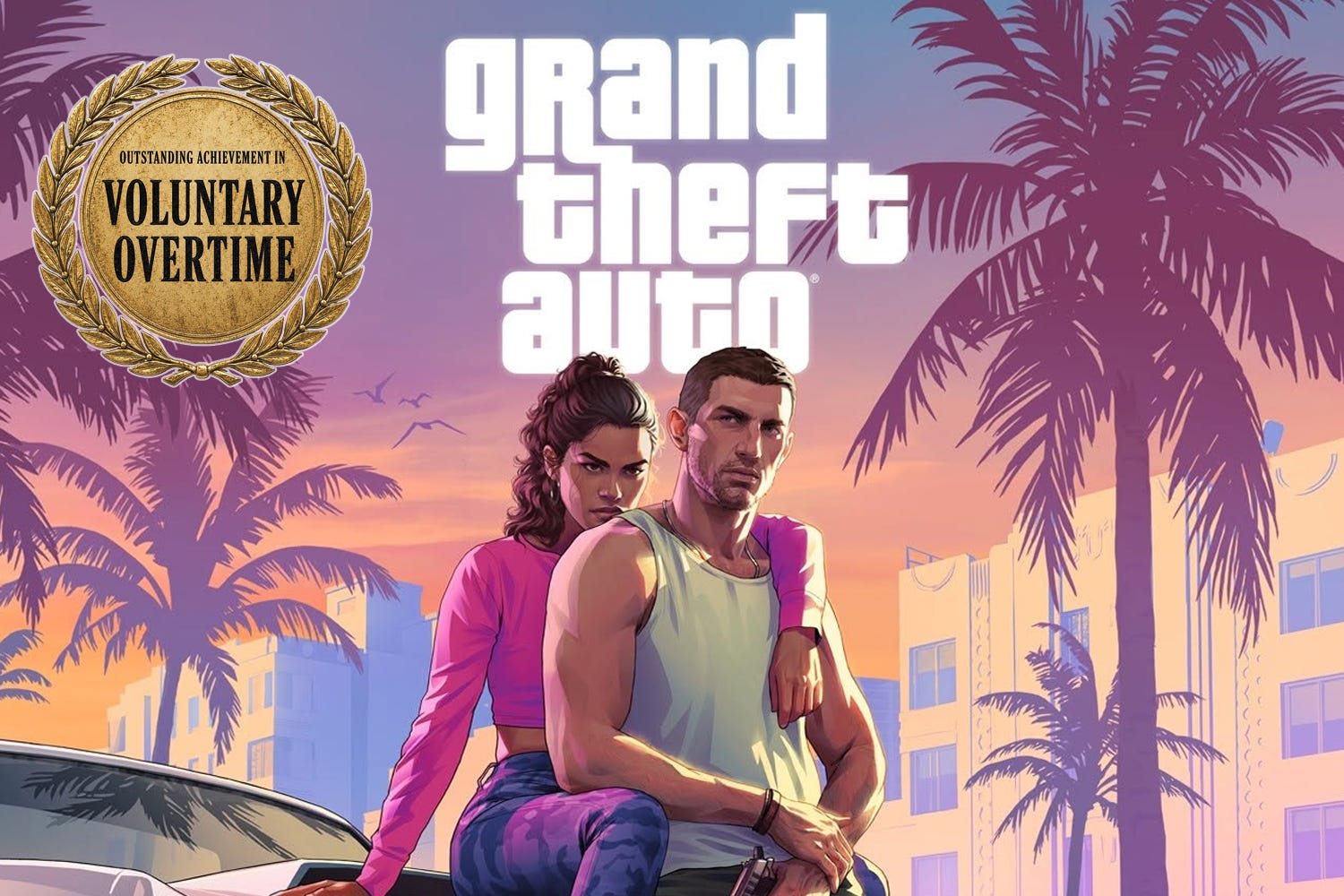
On 30 October 2025, Rockstar Games fired 34 employees across its UK and Canadian offices. The reason given: gross misconduct, specifically the sharing of confidential information in what Rockstar characterised as a public forum. The IWGB, which had been quietly organising inside Rockstar for months, characterised it differently. Their workers had just reached the 10% membership threshold required under UK law to formally seek union recognition. The firings came two days later.
The union’s response, delivered on 28 May 2026, was a video timed to look exactly like a GTA 6 trailer drop.
It was not a trailer.
What happened, in sequence
The timeline documented by GameDev.net and confirmed across multiple sources runs like this:
Workers at Rockstar’s UK studios began organising in early-to-mid 2025, using a private Discord channel set up by the IWGB. In October, they crossed the 10% density threshold. On 30 and 31 October, Rockstar dismissed 31 UK employees and 3 in Canada. All 31 UK workers fired were union members.
Rockstar’s stated position, per a spokesperson quoted by Bloomberg: the workers had been “discussing confidential information in a public forum,” which constituted gross misconduct. The forum in question was the private union Discord. Rockstar also alleged, per TechRadar, that a union staff member may have been impersonated to gain access to the channel.
The IWGB filed unfair dismissal claims immediately. A preliminary tribunal in Glasgow on 5 January 2026 considered a request for interim relief, which would have reinstated the fired workers to Rockstar’s payroll while the full case proceeded. The tribunal declined to grant it. Interim relief carries a high legal bar. The IWGB’s position, per president Alex Marshall: “We’ve come out of last week’s hearing more confident than ever that a full and substantive tribunal will find Rockstar’s calculated attempt to crush a union to be not only unjust but unlawful.”
If this is useful, there's more where it came from. Multiple free posts a week on game production, applied AI, leadership and how the sausage actually gets made.
Meanwhile, 220 current Rockstar employees signed a letter demanding the immediate reinstatement of their colleagues. Three Scottish Labour MPs, Chris Murray, Tracy Gilbert, and Dr Scott Arthur, publicly accused the company of stonewalling legal proceedings. UK Prime Minister Keir Starmer called the case “deeply concerning” at Prime Minister’s Questions and committed ministers to investigate. Protests ran in London, Edinburgh, Paris, and New York.
Union membership, briefly dropped below 10% by the firings, climbed back above the threshold. Then kept climbing.
On 28 May 2026, the Rockstar Game Workers Union publicly launched under the IWGB, covering all five UK studios: Edinburgh, London, Leeds, Lincoln, and Dundee. The launch video hijacked the expectation of a GTA trailer by opening with the exact tone and pacing the community was waiting for, then pivoting to a seven-month account of firings, protests, and legal proceedings.
It has been watched by rather a lot of people.
This is a production story, not an HR story
The game industry and its press have mostly covered this as a labour rights story. It is that. It is also a live production risk on the most expensive game ever made, and almost nobody is framing it that way.
GTA 6 is scheduled for November 19, 2026. The union launched on May 28. That is less than five months from public launch to ship date. In production terms, that is the period when crunch is at its peak, when milestone pressure is at its highest, when the team is most stretched and most dependent on institutional knowledge.
“Behind every success story are tragedies such as layoffs, burnout, and broken promises. The industry must change, and together we will make it happen.” — Rockstar Game Workers Union launch statement, May 2026
That statement was made by people currently building GTA 6. During crunch. While an employment tribunal is confirmed. While their colleagues are running a public fundraiser for the legal defense. While management has, per PC Gamer’s reporting, not publicly responded to the union’s formation in any form.
The three demands are straightforward: pay transparency, flexible working, and an end to crunch. The flexible working demand connects directly to Rockstar’s 2024 return-to-office mandate, which per Spilled.gg required staff in five days a week, citing productivity and security concerns following the major GTA 6 leak. The crunch demand is the direct subject of this series.
None of these demands have been recognised by Rockstar or Take-Two. The union is not yet formally recognised. What it has is a confirmed full tribunal hearing, granted this week, public political support in the UK, and a membership that grew after the company tried to eliminate it.
The suppression playbook failed
From a purely strategic standpoint, what Rockstar did in October 2025 was the standard union-suppression move: identify the organising cohort, find a legally defensible reason to terminate, act before the recognition threshold is formally crossed.
It did not work.
The reason it did not work, in the UK specifically, is that the legal environment is less forgiving than in the US. The Employment Rights Act gives workers meaningful protections. Unfair dismissal claims are relatively accessible. The burden of proving the dismissals were for genuine misconduct rather than union activity will fall on Rockstar in a full tribunal, and their barrister was already characterised as presenting a “smokescreen” during the interim hearing.
More practically: firing 34 people who are organising turns 34 private organisers into 34 public martyrs. The story that was previously invisible inside a private Discord became a parliamentary issue, a protest in four cities, and a globally covered launch video timed to the most anticipated game announcement window of 2026.
As GTA Boom noted, every action Rockstar took to suppress the organising produced the opposite of its intended effect. This is not a novel outcome. It is the documented pattern every time suppression tactics are applied to a workforce that has already committed to organising.
The full tribunal ruling, confirmed this week by The Register, goes further than unfair dismissal. The IWGB will now argue that Rockstar compiled a blacklist, a physical or mental record of workers engaged in union activity, used to identify and target those dismissed. Blacklisting carries specific legal weight in the UK under the Employment Relations Act. Rockstar declined to comment on ongoing legal matters.
One more thing worth noting. Around the time the union launched, Take-Two CEO Strauss Zelnick told Fortune that Rockstar “doesn’t participate in crunch” and that the studio’s focus is “first and foremost on making a quality game.” The workers who just secured a full tribunal hearing on whether their colleagues were blacklisted for organising against crunch had no comment.
Thirty-plus years of production work went into this. Most of it didn’t make the post. New posts every week. Free to read, free to subscribe.
What this means for final production
I’m not going to speculate about whether GTA 6 ships on time. Rockstar has slipped schedules before and delivered eventually. What I will say is that the production conditions for this final push are unlike any AAA title in recent memory.
The team building GTA 6 is simultaneously in final crunch, navigating an active employment tribunal involving their former colleagues, working for management that has publicly declined to engage with their union, and operating under a return-to-office mandate that sits directly against one of the union’s three stated demands.
Crunch and contested labour relations in the same final sprint is not an abstract policy problem. It is a morale problem, a retention problem, and an institutional knowledge problem, all at once, in the window when a studio can least afford any of them.
The Naughty Dog model described in the second post in this series works partly because the contract between the studio and its workers is, however exploitative, clear. Stay, work hard, get a large bonus, leave when you’re done. Everyone understands the terms.
At Rockstar right now, the terms are contested. Management and workers are arguing, through lawyers and a tribunal, about what the terms even were. That is a fundamentally different production environment.
GTA V shipped in 2013 on a team that did not have a union, a tribunal, or 220 colleagues signing reinstatement letters. GTA 6 will ship on a team that has all three. Whether that produces a better or worse outcome for the game is genuinely unclear to me.
What is clear is that the crunch model described in Post 2 of this series, the bonus-incentivised voluntary overtime that Naughty Dog codified after The Last of Us, requires a workforce that has accepted the terms. When a meaningful portion of that workforce has formally and publicly refused them, the model stops being voluntary in any meaningful sense.
The next post looks at the mechanism behind Zelnick’s claim: how bonus-incentivised overtime at studios like Naughty Dog creates crunch without a single written policy requiring it.
This is Post 1 of 3 in The Crunch Files series. Post 2 covers how bonus-incentivised overtime creates crunch without mandating it. Post 3 covers the Game Workers’ Bill of Rights and what the proposals actually mean in production terms.
If this changed how you think about even one thing, the next post might too.
The link "second part of this article" doesn't work btw.
I think there's an interesting angle here on the games vs games as a service (live ops) difference between what will be GTA6 and Naughty Dog games. Where the model, however exploitive, works for Naughty Dog because the games are relatively contained.
GTA6 will be expected to service content for years, if not a decade.
That model contributes to the overall chaos of crunch, by extending crunch ad infinitum.