

Production 101 - #5 Free-to-Play Game Economics (Part 1)
The business model that changed who could play games, and what producers need to know about how it actually works

Game Production Alchemist › Production 101 › Free-to-Play Game Economics: How F2P Works
Free-to-play games are free to download and free to start, generating revenue through in-game purchases and advertising rather than an upfront price.
The model dominates mobile and has a growing presence on console and PC. The top-grossing games in the world are all free.
Producers working on F2P titles need to understand the core metrics: DAU, MAU, retention, ARPU, and conversion rate. These numbers tell you whether the game is working and where to look when it isn’t.
This is Part 1 of a three-part series on F2P economics. Part 2 covers Lifetime Value and user acquisition. Part 3 covers the core loop, engagement mechanics, and the ethics of monetisation design.
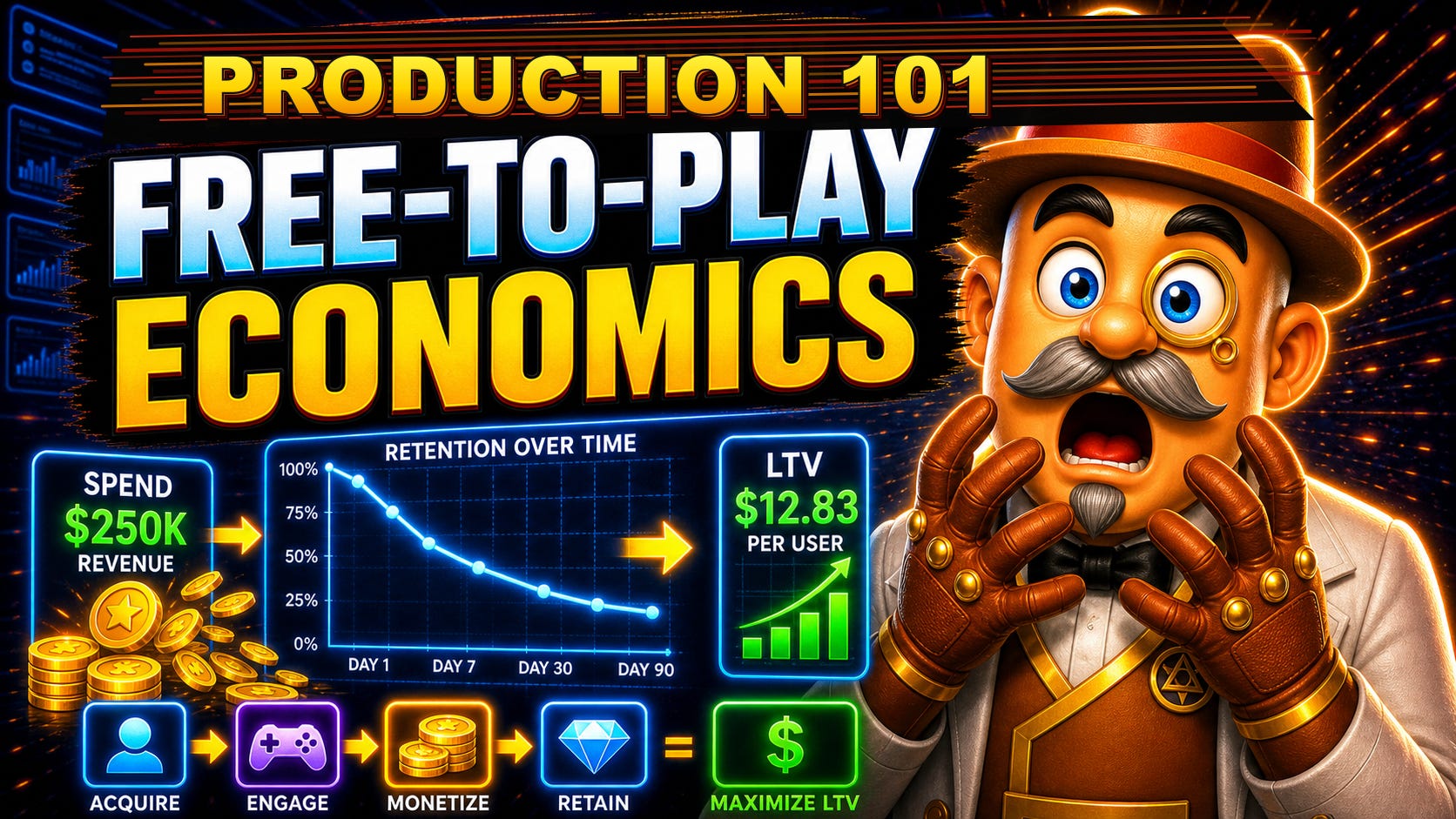
This is post #5 in the Production 101 series, a plain-language guide to game production for people who are new to the craft.
Free-to-play has been the dominant model in mobile gaming for well over a decade, and it didn’t get there by accident. Removing the upfront price barrier meant that anyone with a smartphone could start playing. That was the proposition, and it worked. According to Newzoo’s 2023 Global Games Market Report, mobile games accounted for around $90 billion in revenue that year, and the overwhelming majority of that came from free-to-download titles. The economic logic behind the model is worth understanding properly, because as a producer it shapes almost every decision you’ll be asked to make.
Where the model came from
Free-to-play originated in the late 1990s and spread from markets you might not expect. South Korea and Russia were early adopters, driven partly by widespread high-speed internet access and partly by the practical difficulty of selling boxed retail games into those markets. Titles like MapleStory, a side-scrolling MMO from South Korean developer Nexon, built enormous player bases on a model where the game was free and revenue came from the item shop. The approach spread. Massively multiplayer online games that had launched on subscription models began shifting to free-to-play when they found the subscription wall was limiting their audience more than it was protecting their revenue.
What those early games established was the fundamental structure that still holds today. The base game is free. Players who want to progress faster, look different, or access additional content pay for it. The goal is to make the experience genuinely playable without spending, while making spending feel worthwhile for those who choose to. Getting that balance right is one of the hardest design problems in the industry.
The model in practice: what players actually pay for
The revenue in a free-to-play game comes from a few distinct sources. Understanding the difference between them matters for a producer because each involves different trade-offs.
In-app purchases cover virtual goods, character upgrades, resources and currencies, and temporary boosts. The player buys something that exists only inside the game: a new outfit, a faster production rate, a bundle of the in-game currency they need to make progress. These purchases tend to generate higher revenue per transaction than advertising, but they require players who are willing to spend, and they only work if the spend feels worthwhile.
Advertising revenue works differently. Rewarded video ads offer the player something in exchange for watching a short clip: extra lives, in-game currency, a temporary boost. Interstitial ads appear at natural pause points, between levels or after a session ends. Banner and display ads run during gameplay. The upside is that advertising monetises players who never intend to spend money. The downside is that poorly placed ads damage the experience and drive churn, and even well-placed ads generate relatively small amounts per player. You need scale for advertising revenue to matter.
The freemium model sits across both. The core game is free, but players can pay a one-time or recurring fee to remove ads, access exclusive content, or both. This is common in casual games where the advertising experience is disruptive enough that a meaningful percentage of players will pay to escape it.
The base game has to be genuinely playable without spending. A game that forces payment to continue is a demo with a storefront attached, and players know the difference.
Fortnite, Clash of Clans, and what they actually demonstrate
Two games come up in almost every F2P conversation, and there are good reasons for that. They demonstrate different things.
Fortnite, published by Epic Games, is the clearest example of cosmetic-only monetisation done at scale. The game is free. Nothing you buy gives you a competitive advantage. Revenue comes from character skins, emotes, and seasonal battle passes that unlock cosmetic rewards. According to Sensor Tower estimates, Fortnite generated over $9 billion in lifetime player spending through 2023. The real lesson is that players will spend heavily on things that express identity and status, even when those things have zero mechanical impact. That matters if you’re working on a game where the design team is pushing to monetise gameplay progression rather than cosmetics.
Clash of Clans, launched by Supercell in 2012, demonstrates something different: the longevity of well-calibrated progression monetisation. Players build and defend villages, attack others, and use in-game purchases to speed up timers and acquire resources. The game has been near the top of mobile revenue charts for over a decade. Supercell built a pacing system where time gates create the conditions in which spending feels natural, without feeling forced. That distinction, natural versus coerced, is worth keeping in mind any time you’re reviewing a monetisation proposal.
The performance metrics a producer needs to understand
The metrics that matter in F2P are different from the metrics that mattered in boxed retail. There was no DAU report for a game that sold at a shop counter. There is for everything built on a live model, and producers who can’t read these numbers can’t contribute meaningfully to the conversations that drive decisions.
Daily Active Users (DAU) measures how many unique players opened the game on a given day. Monthly Active Users (MAU) measures how many unique players engaged at any point in a month. On their own, each tells you something. Together, the ratio between them tells you more. A DAU/MAU ratio of 20% means that on any given day, one in five of your monthly players is actually playing. A ratio above 25% is generally considered strong for a mobile title. When DAU drops sharply, I start looking for a specific cause: a bug that shipped, an update that landed badly, a seasonal pattern. When it climbs without an obvious reason, I want to know what changed and whether it’s likely to hold, because a spike you can’t explain can’t be repeated.
Retention rate measures the percentage of players who return after their first session. The industry standard tracking points are Day 1, Day 7, and Day 30. Day 1 tells you whether the first impression was strong enough to bring a player back. Day 7 tells you whether the early progression is holding their attention. Day 30 tells you whether the game has genuine long-term appeal. GameAnalytics’ Mobile Gaming Benchmarks report puts healthy Day 1 retention for mobile at 30-40%, with Day 7 around 15-25% and Day 30 around 5-10%. If your Day 1 is below 25%, the first session has a problem. Fix that before doing anything else.
Retention is the metric most closely tied to monetisation. Players who don’t come back can’t spend. Every day 1 retention problem is also a revenue problem.
Average Revenue Per User (ARPU) is the total revenue in a given period divided by the number of active users in that period. If the game generates £10,000 in a month with 5,000 active users, the ARPU is £2. What this number tells you is how effectively the game is converting its player base into revenue, and whether that efficiency is moving in the right direction. I find ARPU most useful as a relative measure: an ARPU that rises after a content update suggests the update worked. One that falls after a pricing change is telling you the pricing change was wrong.
Conversion rate is the percentage of players who make at least one purchase. In most F2P games, this sits somewhere between 2% and 5% of the active player base, though it varies significantly by genre and audience. That number sounds discouraging until you realise that the remaining 95-98% of players are still contributing. They generate advertising revenue. They fill the social graph that attracts new players. They provide the competitive pressure that motivates paying players to keep spending. The goal is to convert the right people at the right moment, and to keep the non-spenders in the game long enough to matter.
Improving conversion rate rarely comes from a single change. Flexible price points help: a player who won’t spend £9.99 might spend £0.99, and reaching that player is better than missing them entirely. In my experience, timing matters more than price. A well-placed offer at a moment of genuine desire converts far more effectively than a pop-up fired at every player on their third login. I’ve seen limited-time offers double conversion rate when used sparingly, and become invisible noise when they’re permanent. The through-line is making the value proposition clear and the decision easy, without making the player feel manipulated.
Conversion rate improvements built on friction, pressure, or confusion produce short-term revenue and long-term trust damage. Players remember how they were treated.
IAPs versus advertising: the real trade-off
The choice between prioritising in-app purchases and prioritising advertising revenue isn’t a binary one, but it does involve real trade-offs that producers need to be clear-eyed about.
IAP revenue comes predominantly from a small fraction of paying players. According to Appsflyer’s Gaming App Marketing Report, the top 10% of spenders account for around 70% of total in-app purchase revenue, and a much smaller group of high spenders, sometimes called whales, can account for an outsized share of that on its own. That concentration creates both a strength and a risk. The strength is that a small number of highly engaged players can generate substantial revenue. The risk is that if your design alienates non-paying players, you erode the community and the competitive ecosystem that gives the spending any meaning.
Advertising revenue monetises the whole player base, not just the fraction who pay. For a new game without an established paying audience, ads provide immediate cash flow while the paying base develops. The trade-off is that poorly executed ads damage the experience for everyone, including the paying players you most want to retain. I’ve seen games hit their advertising revenue targets for a quarter and then watch their Day 30 retention collapse because the ad experience had become intolerable. Revenue in one period, churn in the next.
The games that get this right tend to treat advertising and IAPs as complementary rather than competing. Rewarded ads give non-payers a path to the same currency they’d otherwise spend money on, which creates a sense of fairness. IAPs give payers a way to get more, faster. Neither experience undermines the other.
In Part 2, I look at Lifetime Value (LTV) and user acquisition: where the financial modelling that underpins F2P games gets more complex, and where a lot of the money is won and lost before a player ever opens the game.
