

Production 101 - #5 Free-to-Play Game Economics (Part 3)
The core loop, engagement mechanics, and the ethics of designing for compulsion

Game Production Alchemist › Production 101 › Free-to-Play Game Economics: How F2P Works
Free-to-play games generate revenue from a tiny fraction of players. Understanding why those players spend requires understanding the core loop.
The core loop is a cycle of collect, upgrade, compete, and reward. Every mechanic in a well-designed F2P game feeds back into that cycle.
Engagement tools like daily rewards, time-limited events, and push notifications are designed to create habits and prevent players from going dormant.
The psychological tactics that make F2P games sticky are the same ones that make some of them ethically questionable. A producer needs to understand both.
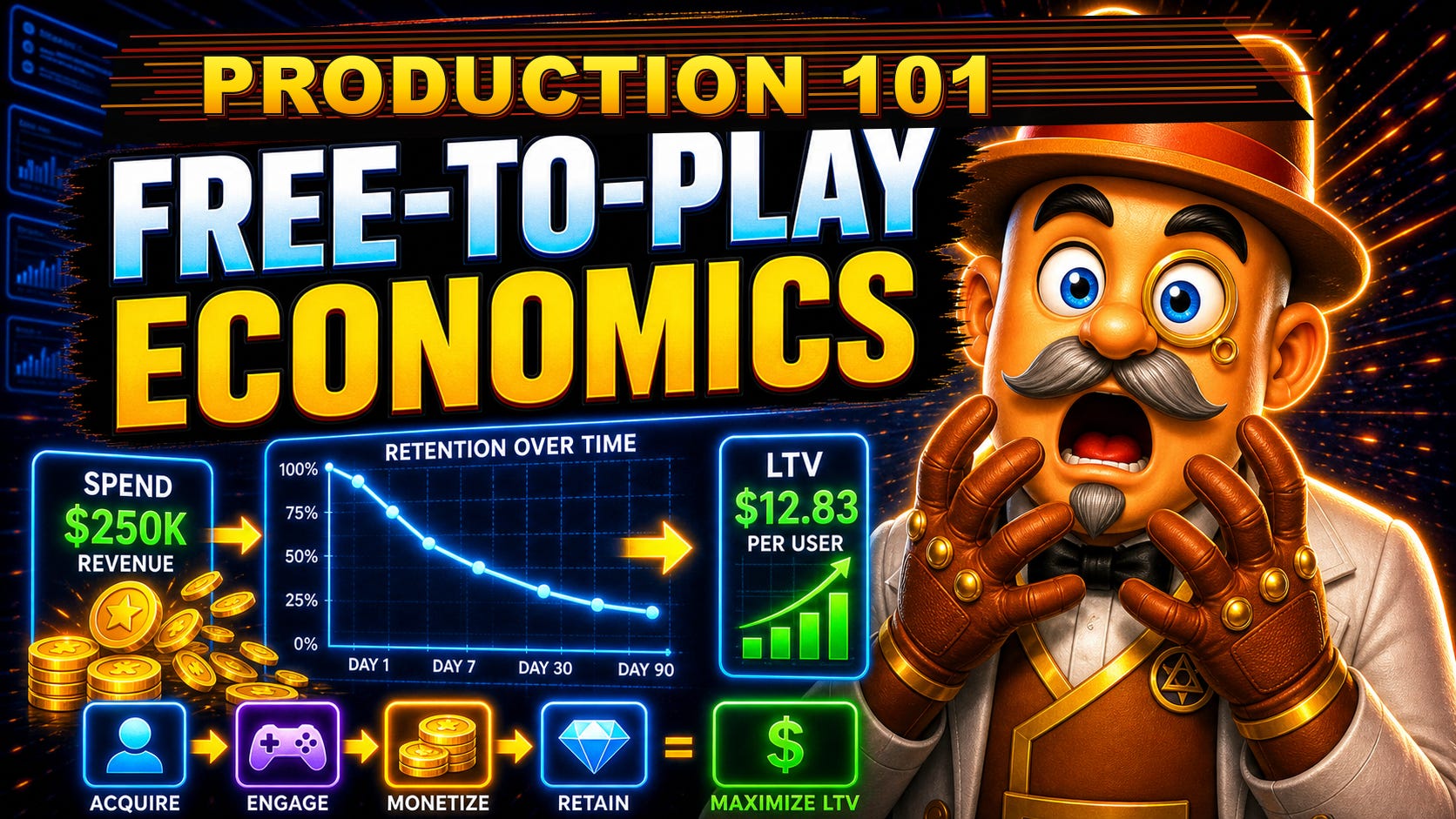
This is Part 3 of Production 101 #5, part of the Production 101 series. Part 1 covered the F2P model foundations, how the major titles monetise, and the core metrics producers need to know (DAU, retention, ARPU, conversion rate). Part 2covered Lifetime Value (LTV) and user acquisition. This part covers the mechanics behind why players spend, and where the model’s ethical problems start.
Free-to-play is the dominant business model in mobile gaming and a growing presence in console and PC. The top-grossing games in the world, Clash of Clans, Candy Crush, Genshin Impact, are all free to download and free to start. And yet they collectively generate tens of billions of dollars a year. According to Sensor Tower’s 2024 Mobile Gaming Report, the top ten mobile titles alone accounted for over $8 billion in player spending.
The business model works because it shifts the payment decision from “do I want this?” to “do I want more of this, right now?” Most players never pay anything. A small number pay occasionally. And a much smaller group, sometimes called whales, accounts for the majority of revenue. According to Appsflyer’s Gaming App Marketing Report, paying players typically represent 2-5% of any game’s active user base, with the top 10% of spenders accounting for around 70% of total in-app purchase revenue.
If you’re going to work in F2P, you need to understand how this actually functions, as a system and as a set of ethical decisions. A producer who doesn’t understand F2P economics can’t write a meaningful spec, and can’t push back when a feature crosses a line.
The F2P model sits at the foundation of what the industry calls live service: games that sustain an ongoing player relationship through regular content and updates well past launch; live ops is the operational practice of planning and running that content cadence, and the two terms appear throughout the industry often interchangeably, though they’re describing different things.
The core loop
The most important structural concept in F2P design is the core loop. It describes the fundamental cycle a player moves through repeatedly, and it’s the thing that keeps them coming back.
The basic shape is always the same: collect something, use it to get stronger, test that strength in a challenge, and receive a reward that feeds back into the collection phase. In Clash of Clans, players collect gold and elixir, use them to upgrade buildings and train troops, attack other players’ bases, and earn more resources from those attacks. The loop is clean, continuous, and self-reinforcing. The reward from one phase immediately fuels the next.
The core loop isn’t a feature. It’s the skeleton everything else hangs off. If the loop has friction or dead ends, no amount of content or monetisation will save the game.
What makes a core loop work is the feeling of progression. Players need to feel like they’re getting somewhere. Upgrades make them stronger. Stronger means winning more. Winning more unlocks new content. New content means new things to upgrade. The loop deepens over time rather than becoming repetitive, which is why pacing matters enormously.
When the loop is well-calibrated, spending money feels like a natural accelerant rather than a requirement. Players who pay are buying time, not access. That distinction is the difference between a monetisation system players tolerate and one they resent.
How games keep players coming back
The core loop handles engagement within a session. But F2P games also need to pull players back to the game day after day. That’s where a layer of meta-engagement mechanics come in.
Daily reward systems are the simplest of these. The game offers increasing rewards for logging in on consecutive days: a small amount of currency on day one, something more substantial on day five, something genuinely valuable on day seven. The mechanics are transparent, but they work anyway. Players develop a habit around checking in daily, and the escalating reward structure means breaking the streak feels like a real loss.
Time-limited events layer urgency onto that habit. A weekly tournament, a seasonal challenge, a weekend-only shop. These force players to engage more intensively during specific windows rather than playing at a leisurely pace. I’ve watched players completely reshape their real-world schedules around in-game events. That’s not an accident. The design is deliberate.
Time-limited events don’t create engagement by themselves. They amplify existing engagement. A game with a broken core loop won’t be saved by a weekend event.
Push notifications are the last resort re-engagement tool. When a player has gone dormant, a well-timed notification about replenished energy, an upcoming event, or a special offer can pull them back in. The word “well-timed” is doing a lot of work in that sentence. Notifications that arrive at the wrong moment, or too frequently, accelerate churn rather than reversing it.
Social mechanics tie all of this together. Leaderboards create competitive pressure. Clan or guild systems create community and social obligation. When your friends can see your ranking, the game stops being a solo activity and becomes something you feel accountable for. That social layer is one of the most powerful retention drivers in the whole toolkit.
The numbers that matter
Producers working on F2P games live and die by a small set of metrics. Understanding what each one tells you, and what it doesn’t tell you, is a basic competency.
Daily Active Users (DAU) and Monthly Active Users (MAU) measure the breadth of engagement. The ratio between them, sometimes called the stickiness ratio, tells you what percentage of your monthly players engage daily. A stickiness ratio of 20% means one in five monthly players opens the game on any given day. A ratio above 25% is generally considered strong for a mobile title.
Retention rate measures how many players come back after their first session. Day 1 retention (the percentage who return the day after installing) is often the most watched metric in early testing. GameAnalytics’ Mobile Gaming Benchmarks report puts healthy Day 1 retention for mobile games at 30-40%, with Day 7 around 15-25% and Day 30 around 5-10%. If your Day 1 retention is below 25%, the core loop probably needs work.
Churn rate is the inverse of retention: the percentage of players who stop playing within a given window. High churn in the first few days usually means onboarding or early pacing problems. High churn after day 30 often means the mid-game isn’t delivering enough variety or depth.
Session length and sessions per user tell you how people are engaging when they do show up. Longer sessions and more sessions per day signal deep engagement. Shorter, more frequent sessions might be fine for a casual puzzle game but could indicate a pacing problem in something with more depth.
None of these metrics tells you why something is happening. That’s where you need to look at progression metrics: which levels are causing players to drop off, where spending spikes occur, where players stop progressing. The numbers point you at a problem. You still have to diagnose it.
The psychology, and the ethics
F2P games use well-documented psychological mechanisms to drive engagement and spending. Being honest about this isn’t cynical. It’s necessary if you want to design responsibly.
The most important is intermittent reinforcement. When rewards are unpredictable, players keep pulling the lever. Loot boxes are the most literal version of this, but the same principle applies to randomised drops, critical hit systems, and anything else where the outcome of an action is variable. The brain treats variable rewards differently from guaranteed ones. The anticipation of a possible reward activates the dopamine system more strongly than a certain reward of equal value.
Artificial scarcity works on loss aversion. “Limited time offer” and “only 3 remaining” create urgency that bypasses rational evaluation. The fear of missing out is a more powerful motivator than the desire to gain. Seasonal items, battle pass exclusives, and time-gated content all draw on this.
The sunk cost fallacy keeps players in games they’ve already invested in. The more time and money someone has put in, the harder it is to walk away. Persistent progression games carry this property by default, whether the designer intends it or not. It absolutely affects spending behaviour.
Understanding these psychological mechanisms is part of the job. Deliberately targeting players who can’t afford to spend, or who show signs of compulsive behaviour, is where it crosses into something indefensible.
Dark patterns sit at the far end of this spectrum. Interfaces that make purchases trivially easy but refunds deliberately hard. Pop-ups timed for moments of frustration. Currency systems that obscure real-money costs. These are traps, and they’re increasingly attracting regulatory attention.
The loot box debate has been running for years. Belgium and the Netherlands classified certain loot box implementations as gambling and banned them. The UK Gambling Commission has issued guidance. Several countries now require probability disclosures. As a producer, you need to know where your game operates and what the legal requirements are. More fundamentally, you need to be able to look at a monetisation feature and say whether it’s designed to generate value for the player or purely to extract money from a psychological weakness.
South Park’s 2014 episode “Freemium Isn’t Free” satirised this with more precision than most industry commentary has managed. The show’s version of Terrance and Phillip: Give Us Your Money portrayed the freemium model as a collaboration between the Canadian government and Satan, explicitly designed to exploit addictive personalities. It was a joke, but the mechanics it described were accurate: intermittent rewards, social pressure, and the deliberate targeting of compulsive behaviour. The episode aired over a decade ago, and the industry hasn’t fully resolved the questions it raised.
What this means for a producer
A game producer working on an F2P title isn’t just managing a schedule. You’re making constant decisions about where the line is.
You need to understand the metrics well enough to know what the team is optimising for and whether those targets make sense. DAU targets divorced from quality targets can push a team toward dark patterns without anyone explicitly deciding to go there. Retention at all costs produces different design choices than retention alongside fair conversion.
You need to be able to read a monetisation proposal and evaluate it honestly. Does this create genuine value for the player? Does it respect the player’s ability to make an informed decision? Is it targeting a psychological weakness in a way that will create short-term revenue and long-term trust damage?
And you need to be able to scope and prioritise work against business objectives that you actually understand. A producer who doesn’t know what a stickiness ratio is can’t have a useful conversation about whether a new social feature is worth building. A producer who doesn’t understand intermittent reinforcement can’t evaluate whether a new reward system is well-calibrated.
