

Production 101 - #3 Role of an Internal Producer (Part 2)
The tools, relationships, and daily trade-offs that define the job

Game Production Alchemist › Production 101 › What Does an Internal Game Producer Do?
An internal producer’s toolkit goes well beyond office software: project management platforms, build systems, source control, and asset pipelines are all fair game.
Soft skills carry more weight than any tool. Social capital and emotional intelligence determine whether a producer can actually move things forward.
Communication is where most production failures start. Getting it right means the team ships on time, leaves at a reasonable hour, and doesn’t hate each other.
AI and probabilistic forecasting are changing how producers plan. The producers who adapt earliest will have a real advantage.
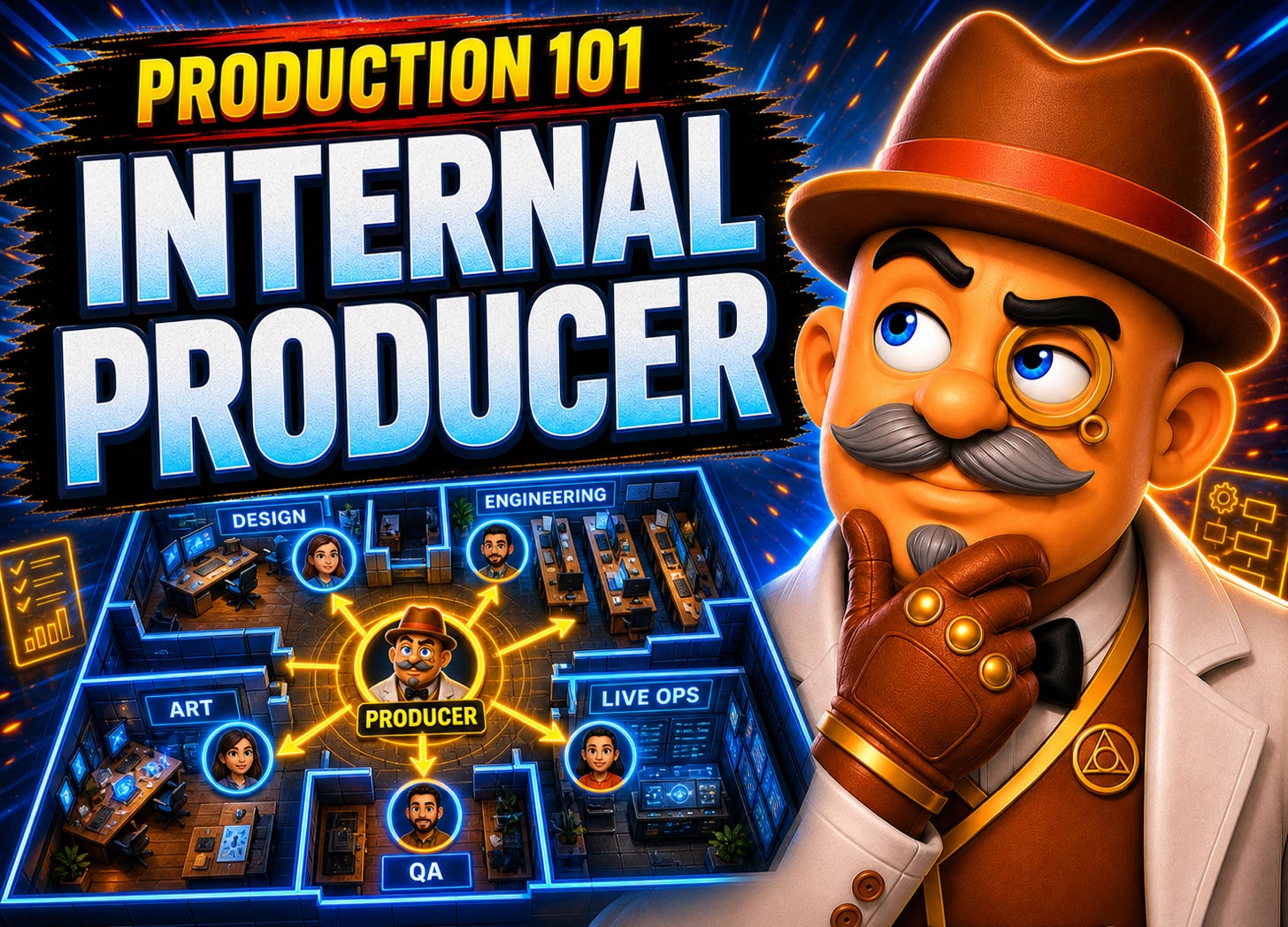
This is Part 2 of Production 101 #3, part of the Production 101 series. Part 1 covered the role overview, dual accountability, key responsibilities, entry paths, and a day-in-the-life sketch. This post picks up with the practical side: what internal producers actually use, how they work with each department, and what the job feels like from the inside.
If this is useful, there's more where it came from. Multiple free posts a week on game production, applied AI, leadership and how the sausage actually gets made.
Tools of the Trade
People assume a producer’s toolkit is mostly calendar software and spreadsheets. It’s a lot more than that.
At the foundation, yes, you need to know the project management platform the studio uses, whether that’s Jira, Hansoft, Shotgrid, or something homegrown. You also need a working knowledge of the internal wiki or documentation system, because information that lives only in someone’s head is a liability. But the tools that separate a competent producer from a good one sit further down the stack.
A working understanding of the build system matters more than most producers admit early in their careers. You don’t need to be able to configure it, but you do need to understand what it does: how code and assets move from a developer’s machine to a testable build, and where things can break in that process. When something goes wrong with a daily build, you’re the person coordinating the response. Not knowing roughly what happened slows everything down.
Source control is similar. You won’t be branching and merging, but you need to understand the concepts well enough to have an informed conversation with an engineer about why a feature can’t ship this cycle.
“The tools that separate a competent producer from a good one sit further down the stack.”
The same applies to asset control pipelines for art and audio. Large game projects involve hundreds of contributors working on interdependent files. Understanding how assets are versioned and integrated means you can spot dependency problems before they become blockers.
All of that is table stakes. The tools that actually make the difference are the soft ones.
Social capital is a real resource. It’s built slowly and spent quickly. I’ve seen producers who had every process nailed down but couldn’t get anything done because no one wanted to do them a favour. The producers who could pick up the phone at 5pm on a Friday and get a designer to fix something for a demo tomorrow had spent months building that goodwill. It doesn’t happen by accident.
Nemawashi is worth knowing as a concept even if the word sounds obscure. It’s a Japanese term for the practice of laying the groundwork before a formal decision, talking to stakeholders informally before you’re in the room so there are no surprises. Producers who skip this step walk into meetings expecting agreement and walk out having to redo their plans. Producers who do it consistently find that decisions go faster and people feel heard.
Emotional intelligence and active listening are harder to teach than any software, but they matter more than most of the rest combined. A creative team under pressure is not always a rational team. Reading the room, knowing when to push and when to back off, understanding what someone actually means when they say “this is fine” - these are skills that only come with practice and attention.
Working with the Team
An internal producer touches every department in the studio. That’s what makes the role different from most other positions on a game project.
On a typical day, you’ll have touchpoints with art, design, engineering, QA, and product management. On projects with a creative director, that relationship is also a regular part of the producer’s week, with its own specific dynamic covered in [INTERNAL LINK: Post #25 — Working With a Creative Director]. Some of those will be structured, like a daily standup or a sprint review. Many will be informal: a quick message to check on a blocker, a five-minute conversation to clarify a requirement that has become ambiguous. The producer’s job is to maintain situational awareness across all of them simultaneously.
That creates a particular challenge when departments speak different languages. Engineers and artists often have genuine difficulty communicating requirements and constraints to each other. Not because either group is unclear in isolation - each is perfectly coherent within its own frame of reference - but because the vocabulary doesn’t map cleanly. Part of the producer’s job is translation. You learn enough of each discipline’s language to represent one accurately to the other.
“Social capital is a real resource. It’s built slowly and spent quickly.”
Where the studio has an external publishing partner, the internal producer typically becomes the primary interface between development and the publisher. This means representing the team’s reality accurately to people who may not understand the technical constraints, while also communicating the publisher’s requirements to a team that sometimes views them as arbitrary. Both sides will sometimes be annoyed with you. That’s roughly how you know you’re doing the job.
Finance is often an overlooked dependency. Budget management and vendor payments involve the finance team, and that relationship can go badly if a producer treats it as an administrative formality. Building a good working relationship with finance early saves time and goodwill when the inevitable complexity arrives.
The common thread across all of these relationships is that the producer doesn’t own any of the work directly. The engineers write the code, the artists make the assets, the designers specify the features. The producer’s job is to create conditions where all of those people can do their best work, and to catch the problems that fall between the cracks in a structure where everyone is responsible for one part but no one is responsible for the whole.
Communication and Why It Fails
The game industry has a habit of attributing production failures to bad luck, inadequate technology, or scoping problems. In my experience, most failures trace back to communication. Specifically, to the assumption that information was shared when it was received but not understood, or understood but not acted on, or acted on in the wrong direction.
The producer’s role is to build systems where information moves reliably, to verify that critical things were actually understood, and to create an environment where people raise problems early rather than hoping they’ll resolve themselves.
“Most failures trace back to communication. Specifically, to the assumption that information was shared when it was received but not understood.”
What that looks like in practice:
A clear definition of what “done” means for any given task. Not “development complete” or “QA sign-off” but an unambiguous description that leaves no room for different people to hold different mental models. This sounds obvious and it takes work to maintain consistently, especially when the project is moving fast and the temptation is to leave things slightly vague to avoid an argument.
A reliable escalation path when something goes wrong. The team needs to know what to do when they’re blocked. A producer who is difficult to reach or slow to respond to blockers creates a culture where people either waste time waiting or make decisions unilaterally that create downstream problems.
Regular communication with stakeholders outside the immediate team. Surprises at milestone reviews are expensive. They’re almost always preventable with earlier, more frequent communication that makes incremental progress visible before it becomes a formal checkpoint.
When a project stays on schedule, when milestones pass without drama, when the team consistently ships features and leaves at a reasonable hour, it’s rarely because nothing went wrong. It’s because communication was good enough that the things which went wrong got resolved before they compounded.
Thirty-plus years of production work went into this. Most of it didn’t make the post. New posts every week. Free to read, free to subscribe.
Impact and the Work That Doesn’t Show Up in a Portfolio
The most visible impact of an internal producer is on the schedule: milestones hit, features shipped on the announced date, revenue-generating events going live as forecast. This matters and it’s measurable.
The less visible impact is on the work environment. An internal producer who manages scope well, keeps stakeholder expectations calibrated, and resolves interpersonal friction early creates conditions where the team doesn’t have to crunch.I’d argue this is the more significant contribution, because crunch is corrosive to both quality of work and people’s long-term ability to stay in the industry.
The team doesn’t often attribute this to the producer directly. That’s normal. If the project is running smoothly, people tend to attribute it to the project running smoothly. If a fire breaks out and the producer puts it out quickly, the team might notice. The fires that never start because of good planning are invisible.
“If the project is running smoothly, people tend to attribute it to the project running smoothly.”
What I’ve found rewarding about the role is different from what I expected when I started. I thought the satisfaction would come from shipping games, and it does. But the thing that actually keeps me in production is watching a team work well together. A creative team that trusts each other, communicates honestly, and has the space to do good work will produce something better than a team with the same raw talent that’s poorly managed. A producer who creates those conditions has done something real, even if it doesn’t show up anywhere in the credits.
Challenges, Pressures, and Getting the Balance Right
The hardest part of being an internal producer is the position you occupy between the business and the team.
The business needs predictable delivery, cost control, and features that hit the market when the market is ready for them. The team needs time to build things properly, reasonable working conditions, and enough creative latitude to produce work they’re proud of. These two sets of needs are not always compatible. The producer’s job is to negotiate the space between them.
This doesn’t mean splitting the difference every time. Sometimes the business need is correct and the team has to move faster than they’d like. Sometimes the team’s assessment of what’s feasible is right and the business expectation needs to be reset. The skill is in knowing which situation you’re in and making that case clearly.
The pressure that comes with this role is real and doesn’t always stay at the office. When a milestone is at risk, when the budget is tight, when quality isn’t where it needs to be to ship, that weight tends to follow a producer home. I don’t have a clean solution for that. What helps, in my experience, is clarity about what you can control and acceptance about what you can’t. Most of what a producer worries about at 11pm is not improved by worrying about it at 11pm.
The rewards are worth noting because they’re often obscured by how difficult the work sounds from the outside. Seeing a project through from kickoff to launch, knowing the specific decisions you made and problems you solved contributed to a game that players are now enjoying, is genuinely satisfying. The camaraderie of a team that shipped something together is real. And there is a particular pleasure in a sprint review where the demo works, the stakeholders are satisfied, and everyone goes home on time.
How the Role Is Changing
AI is the most significant near-term change to how internal producers work, and I think the producers treating it as a novelty are already behind.
The practical applications are immediate. Large language models are genuinely useful for drafting documentation, writing acceptance criteria, breaking down epics into user stories, summarising meeting notes, and preparing stakeholder reports. These are tasks that used to consume a significant portion of a producer’s week. They don’t need to anymore. The time that frees up can go toward the judgment-intensive work that AI can’t replicate: understanding what the team actually needs, reading a situation, making the call on a scope trade-off.
The shift toward probabilistic forecasting is changing how producers communicate timelines. Traditional project management gives you a single delivery date, which creates a false precision and sets everyone up for disappointment when reality diverges from the plan. Probabilistic forecasting uses historical velocity data to model a range of likely outcomes. Instead of “we’ll ship on March 15,” you get “there’s a 70% chance we’ll ship before March 22.” This is more honest and, in practice, more useful for stakeholder conversations.
The industry is also in a period of contraction. Layoffs have been widespread and studios are under pressure to do more with fewer people. I don’t expect that pressure to ease substantially in the near term. What it means for producers is that efficiency matters more, the ability to manage scope under constraint is a core skill rather than a nice-to-have, and the producers who can show direct impact on delivery will be the ones who keep their jobs when teams are restructured.
None of this changes the fundamentals of the role. A producer still needs to understand their team, manage their stakeholders, maintain clear communication, and create the conditions for good work. The tools and the economic context change. The underlying job doesn’t.
The next post in this series looks at the external producer - a different but closely related role with some important distinctions worth understanding.

If this is useful, there's more where it came from. Multiple free posts a week on game production, applied AI, leadership and how the sausage actually gets made.