

Production 101 - #3 Role of an Internal Producer (Part 1)
The dual accountability at the heart of the role, and what it actually takes to do the job, relationships, and daily trade-offs that define the job

Game Production Alchemist › Production 101 › What Does an Internal Game Producer Do?
An internal producer is accountable to two things simultaneously: the schedule and the team. Those two accountabilities are not always in tension, but managing both honestly is what defines the role.
The responsibilities span schedule planning, cross-department coordination, budget management, scope control, risk management, and stakeholder communication.
There is no single correct path into internal production. QA, development roles, and product management are all common starting points.
The shape of the role depends heavily on studio size. A small studio’s internal producer is a generalist covering most of production; a large studio’s is typically a specialist owning one area deeply.
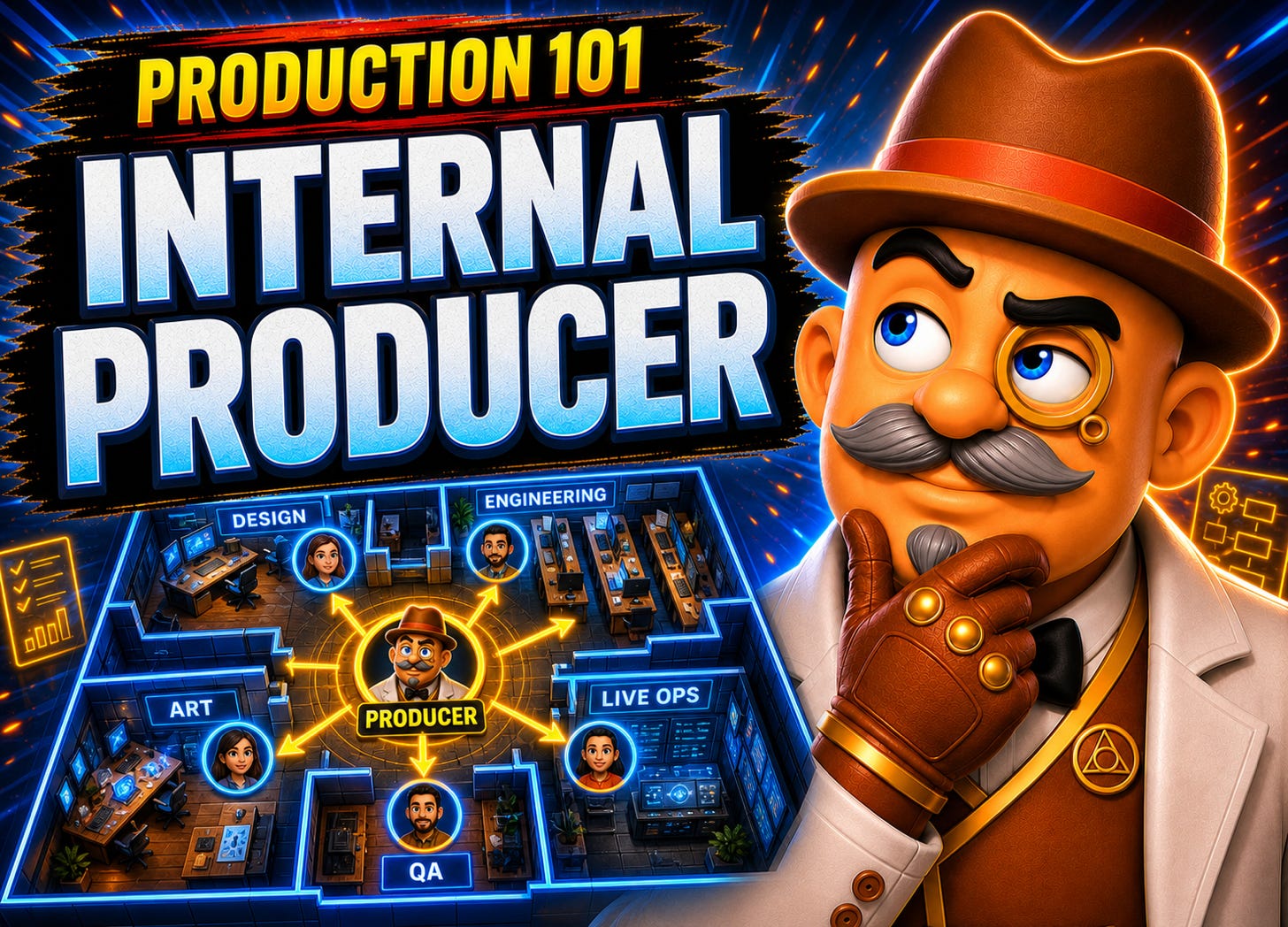
This is part of the Production 101 series. Post #2 covered the specific roles and levels in a studio’s production hierarchy. This post focuses on the internal producer specifically: what the role is structurally, what it requires of the person doing it, how people arrive at it, and what a working day looks like in practice.
If this is useful, there's more where it came from. Multiple free posts a week on game production, applied AI, leadership and how the sausage actually gets made.
What the Internal Producer Actually Is
People often describe the internal producer as a project manager, and that description is accurate as far as it goes. The internal producer does manage the project. But the framing misses something that matters.
An internal producer carries two distinct accountabilities. The first is to the delivery: the schedule, the milestones, the deliverables, the expectations of everyone outside the team who has a stake in the outcome. This is the accountability most people think of when they think of production. It’s visible, it’s measurable, and when it goes wrong, everyone notices.
The second accountability is to the team: their capacity, their wellbeing, and the sustainability of their working environment. This one is less visible, but it shapes whether the team can keep functioning at a high level across the months and years a production actually takes. A producer who treats it as secondary tends to find that hitting short-term milestones comes at the cost of team stability, and that instability shows up in the work eventually.
“An internal producer carries two distinct accountabilities. The first is to the delivery. The second is to the team.”
The internal producer sits between the game’s vision and its execution. They don’t set the creative direction. They don’t write the code or build the assets or design the systems. What they do is create the conditions where all of those things can happen reliably, at a pace the team can sustain, to a standard the project requires.
That dual accountability is the structural truth of the role. Everything else in this post is detail that sits underneath it.

What the Role Requires Day to Day
The responsibilities of an internal producer tend to fall into a set of recurring areas, though how much time any one of them takes depends on the phase of production and the studio’s size.
Schedule planning and milestone tracking are the foundation. The internal producer builds the production plan, maintains it as the project changes, and keeps track of whether the team is on course to hit the next milestone. This is not a static document updated once a week. It’s a living picture of where the project is, which requires constant input from every department.
Cross-department coordination is where much of the practical work lives. Art, design, and programming are all producing interdependent output, and the dependencies between them need active management. An artist can’t finish a character if the design specification is still in flux. A programmer can’t integrate a feature if the build is broken. The internal producer is the person monitoring those dependencies and moving things before they become blockers.
Budget management sits alongside the schedule. The internal producer owns the financial picture of the project: what was budgeted, what has been spent, what is committed, and where the gaps are. On smaller teams the producer may own vendor relationships and payments directly. On larger productions there’s usually finance involvement, but the producer remains accountable for knowing the numbers.
Scope management and risk management are related. Scope will change during any production. Features get added, features get cut, platform requirements shift, playtest feedback reveals something that needs rethinking. The internal producer’s job is to manage those changes in a way that doesn’t quietly move the goalposts for everyone else. Risk management is the forward-looking version of the same work: identifying what could go wrong before it does, and building contingency into the plan while it’s still possible.
Stakeholder communication runs through everything. Publishers, investors, studio leadership, and platform holders all need a picture of where the project is and where it’s going. The internal producer is typically responsible for that picture. Getting it wrong in either direction, by being too optimistic or too pessimistic, causes different problems but both are expensive.
“Scope will change during any production. The internal producer’s job is to manage those changes in a way that doesn’t quietly move the goalposts for everyone else.”
Quality assurance sits in a complicated relationship with production. The internal producer doesn’t run QA, but they do own the conditions that let QA do its job: making sure builds reach the testing team in a state worth testing, that defect tracking is integrated into the milestone picture, and that feedback from playtests gets into the development process in a form designers and engineers can act on.
Most productions of any size use some flavour of agile methodology. Scrum and Kanban are the most common, though studios frequently run hybrids adapted to game development’s particular rhythms. The internal producer needs to understand the methodology well enough to run it intelligently, to know when to hold the process and when to adapt it, and to explain to the team why the process serves the work rather than the other way around.
Thirty-plus years of production work went into this. Most of it didn’t make the post. New posts every week. Free to read, free to subscribe.
Who Becomes an Internal Producer?
There is no degree that leads directly to internal production, and no single career path that defines it. I’ve seen people arrive in this role from every direction, and the variety is genuine rather than the result of a permissive industry.
The most common starting point is game testing. QA work builds familiarity with the full project across all disciplines, and a good QA lead is already doing a version of production work: tracking issues, coordinating responses, managing relationships with multiple teams. The step into production is a natural one for someone who has been paying attention to how the project works rather than just cataloguing defects.
Development roles are another path. Programmers, artists, and designers who find themselves drawn to the whole project rather than just their piece of it sometimes move across. They bring something that pure administrators don’t: a working understanding of how the craft actually happens, which makes them more credible in conversations about feasibility and risk.
Product management from outside the games industry has become more common as studios have grown and professionalised. The planning and stakeholder management skills transfer well. The gap is games knowledge, and that can be closed over time, though it takes longer than people expect.
Education backgrounds in the people I’ve worked with span game design, computer science, digital media, business, humanities, and several things I wouldn’t have predicted. What they have in common is less about what they studied and more about what they developed: the ability to organise complex work, communicate clearly across people with genuinely different working languages, and think about the project as a system.
“The variety of routes into internal production is genuine rather than the result of a permissive industry.”
One thing I’d add, based on what I’ve seen across thirty years: the people who do well in this role tend to be the ones who were always asking questions at whatever they did before. The QA tester who wanted to know why a design decision was made that way. The programmer who noticed how the team’s morale changed when planning slipped. That curiosity about the whole, rather than the part, is usually already present in the people who go on to produce well.
What the Job Actually Looks Like
I’ll describe what a production day looks like for me, with the caveat that every project has its own rhythm and no two days are identical.
The morning starts with standup, and with checking whatever has come in overnight. On multisite projects or anything with partners in different time zones, overnight can mean anything. I want to know before standup whether anything has changed that affects what I’m going to say, so I’m reading messages and build reports before I’m in the room.
Standup itself is a fifteen-minute read on the state of each department. The goal is the team hearing each other’s blockers and making decisions about them. My job in that room is to ask the questions that don’t get asked without prompting, and to take note of the things that need follow-up.
The mid-morning is usually where the deeper work happens, before the afternoon fills with calls. This is when I’m in conversations with art about where a batch of assets is relative to where it needs to be, or with design about whether a feature has drifted from the original specification in ways that will cause downstream problems. These conversations are often shorter than I expect, and more useful than any written update I could have asked for.
Lunch is not a productivity opportunity. It’s the time I’ve found most useful for understanding how the team is actually doing, which is different from how the project is doing. Those two pictures sometimes diverge, and you notice it earlier in an informal conversation than you do in any structured check-in.
The afternoon shifts toward the outward-facing side of the role. This is typically when I’m putting together updates for whoever the project is accountable to externally: the publisher, the platform partner, studio leadership if that’s a separate relationship. The discipline of preparing those updates is useful even on projects where nobody is watching closely, because it forces me to know whether the picture I’m presenting is the one I actually believe.
Late in the day is when I’m catching things that have slipped through the rest of it: tasks that have stalled without explanation, dependencies that have shifted, anything that looks like it needs to be in the plan but isn’t yet. I do most of my documentation at this point too, because the decisions made during the day need a record, and that record rarely exists without someone deliberately creating it.
“The decisions made during the day need a record, and that record rarely exists without someone deliberately creating it.”
The end of the day is preparation for the next one. Not the next week, not the next milestone. The next day.
How Studio Size Changes the Role
One thing the job title doesn’t tell you is how much the role varies depending on where you’re doing it.
At a small studio, the internal producer is effectively covering all of production. You’re planning the schedule, managing the budget, running standups, coordinating with any external partners, handling stakeholder communication, and doing the administrative work that keeps the project moving. There may be no one else in the production function. You are it.
At a large studio, the same title describes something much more specific. You might own the schedule for one content track, or be the production lead for a single feature team, with other producers covering adjacent areas. The depth is greater and the scope is narrower. You’re a specialist, and the studio expects you to be.
Neither version of the role is better than the other. They develop different skills. The small studio producer develops range: the ability to pick up any production problem and address it. The large studio producer develops depth: a detailed understanding of how one part of the production machine works.
If you’re at the start of your career and trying to decide which environment to aim for, the honest answer is that both will teach you things the other won’t. What matters is being clear about which version of the job you’re actually taking on, because the gap between what the title implies and what the role requires is sometimes significant. A producer hired for a large studio’s specialist track who expects the breadth of a small studio producer will be frustrated. The reverse is equally true.
The other variable is methodology. Some studios are committed to Scrum. Some run Kanban. Most all use hybrid approaches that have developed over years to fit specific production contexts. The internal producer needs to be fluent enough in the underlying principles that they can work in any of these environments, because the studio’s process is a given by the time you arrive.
Part 2 of this post covers the tools of the trade, how the internal producer works with each department, why communication is where most production problems start, and the longer-term challenges and rewards of the role. Production 101 #3: Part 2 - The Tools, Relationships, and Daily Trade-offs picks it up from there.

If this changed how you think about even one thing, the next post might too.