

Production 101 - #26 Producing Across Time Zones
The specific disciplines that keep distributed teams shipping

Game Production Alchemist › Production 101 › Remote Game Production: Producing Across Time Zones
Remote production requires you to build deliberately what co-located teams get for free: ambient awareness, fast decisions, and the relationships that make honest communication possible.
Any information that can travel in writing should, and on a distributed team that rule is not optional.
The default-to-meeting reflex is expensive on any team and destructive on a remote one.
The practices that remote work forces on good studios: written decisions, documented rationale, async communication. They’re worth keeping even after the offices reopen.
Production 101 is a series for people entering or early in game production. Series index.
Remote production is not in-person production with a longer commute. The gaps are different. The ambient awareness that comes from sitting near the team, knowing that someone’s been quiet for two days, catching a conversation in passing that tells you something is wrong, doesn’t exist across time zones. You have to build deliberately the things that used to happen by accident.
I’ve spent a significant portion of my production career working with teams I couldn’t walk to. Some of that was co-development with external studios in other countries, some was fully distributed internal development, some was a mixture. The shape of the work is genuinely different, and treating it as a logistics variation on in-person production is a reliable way to end up managing a team you can’t actually see.
What the floor gave you
The producer who walks the floor gets constant low-resolution signals about team state. You know who’s in early, who left late, who’s been unusually quiet in the open space, who’s been having a lot of side conversations. None of this is surveillance. It’s the background information that helps you calibrate whether the team’s written reports match what the team actually looks like. That calibration is lost entirely in a remote context.
The other thing you lose is the speed of informal resolution. Questions that would take five minutes in a hallway take twenty-four hours when each message and reply crosses a time zone. A designer who needs a fast answer from engineering, and can’t get it before they leave for the day, loses a full working day to a question that a two-minute conversation would have resolved. When that pattern repeats across a team at scale, the delay compounds quickly.
Documentation gaps become critical for different reasons. On a co-located team, information lives in people and can be retrieved by asking. “What was the decision we made about save system architecture?” has an answer someone in the building can give you. On a distributed team, information that is not written down effectively does not exist. It may exist in someone’s memory, in a time zone that is currently asleep.
Reading emotional state also requires different effort. The bandwidth of a video call is much lower than in-person presence. The engineer who seems fine in a ten-minute standup might not be fine. The absence of non-verbal context: posture, energy, how they interact with others before and after the meeting. You’re working with less signal than you’re used to. You compensate by asking more directly, more frequently, and building the kind of relationship where people will actually tell you things.
Synchronous versus asynchronous work
The clearest decision a remote producer makes is what belongs in real time and what belongs in writing. Most teams get this wrong in one direction: they default to meetings because meetings feel like work, and writing feels like additional work.
Synchronous time is for decisions that need debate. Not the final ratification of a decision that was already made, but the genuine back-and-forth where the outcome depends on people building on each other’s thinking in real time. It’s for situations that need emotional attunement, where someone on the team is struggling and a written message is inadequate to the stakes. It’s for team moments that build relationship: not standup, but the conversations that remind people they’re working with humans.
Everything else should be asynchronous. Status updates. Non-urgent questions. Decisions with clear owners and well-understood options. Progress reporting. Any information that will need to be referenced again, which is most information. A daily standup is a useful example of how the calculus changes: in a co-located team it costs fifteen minutes and a walk down the corridor; across time zones, the same meeting imposes a fixed cost on someone’s off-hours every day, and the format that barely registers as overhead in an office can quietly accumulate into the thing that wears remote teams down.
The default-to-meeting reflex creates an expensive and exhausting remote culture. The async-first producer designs around this explicitly.
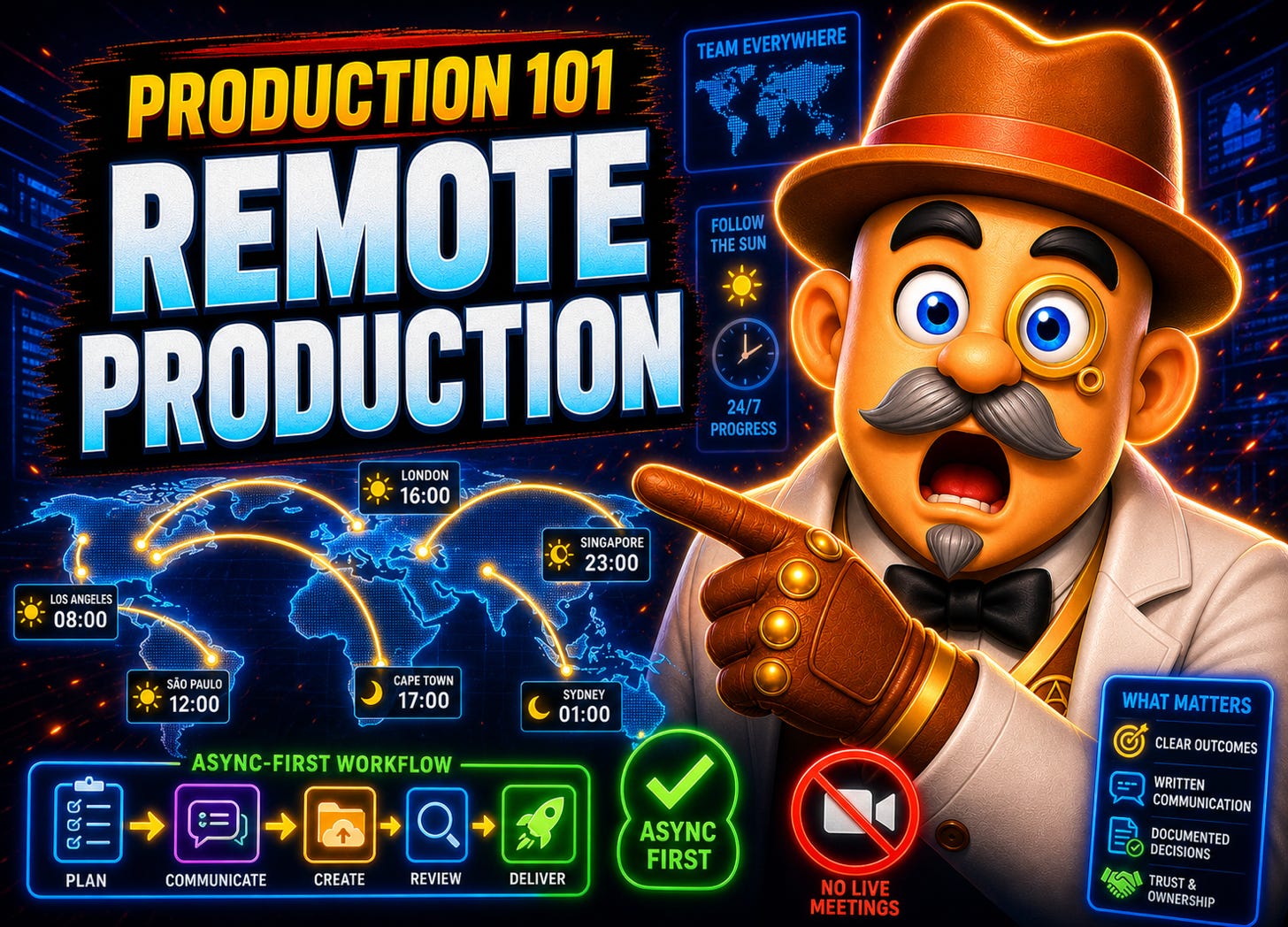
The problem with defaulting to meetings in a remote context goes beyond cost. When your team spans multiple time zones, every synchronous meeting imposes a cost on someone working outside their core hours. A 9am meeting in Los Angeles is a 5pm meeting in London and a midnight meeting in Singapore. The team member in Singapore pays a cost that the one in Los Angeles never notices. The async-first producer designs the workflow so that synchronous meetings are rare enough to be worth attending, and timed with awareness of who’s carrying the overlap burden.
If you haven’t already read how to apply this thinking to meeting design specifically, [INTERNAL LINK: Post #18 - Running Meetings That Aren’t a Waste of Time] goes into the full framework.
Documentation as load-bearing infrastructure
On a co-located team, documentation is a nice-to-have. Someone will write it when there’s time, and when there isn’t time, someone can just ask the person who was in the room. On a distributed team, documentation is infrastructure. The team cannot function without it.
The specific failure mode I’ve seen most often is the decision that happens in a meeting and goes nowhere in writing. The people in that meeting know what was decided. Everyone else, including the half of the team that was asleep when the meeting ran, does not. They find out the hard way, when they’ve been working against an assumption that the meeting changed.
I developed the habit, early in distributed work, of writing a short decision record after any meeting where something was agreed. Not minutes in the traditional sense. A document that states what was decided, why, who owns the follow-through, and what the alternatives were. It takes ten minutes. It has, reliably, prevented weeks of misalignment.
The producer’s responsibility here extends beyond their own documentation. Every meeting needs written notes with action items and named owners. Every project status needs a written form that doesn’t require attending a call to understand. The team status report that someone in a different time zone can read on Monday morning and know exactly where the project stands: that’s the product you’re building when you write it. The team exists as a shared entity across geography because of the written record. Without that record, it exists only for the people who were awake at the same time.
Building relationships without the floor
The working relationships that form naturally in a physical office, sitting next to someone for six months, sharing a meal, being present when something difficult happens, require deliberate effort at a distance. This is not a soft consideration. Team relationships are the mechanism by which you get honest information. Producers who treat relationship-building as optional overhead in a remote context end up managing via formal channels, which means they’re always getting filtered information and never the thing that actually matters.
What actually works: regular one-on-ones with video on, not just project status check-ins. Time specifically for the person rather than the task. Intentional casual conversation that isn’t prefaced by an agenda. Team rituals that are not work: the shared channel for things that aren’t about the game, the informal moments that exist in physical offices as a byproduct and have to be scheduled when they don’t.
The evidence on what builds remote trust consistently points toward frequency of low-stakes interaction over quality of high-stakes ones.
Visiting in person matters when the opportunity exists, even briefly. Two days in the same room with someone resets the relationship baseline in a way that hours of video calls do not. I’ve seen this happen repeatedly: teams that seemed to be communicating well at a distance became dramatically more effective after a week of co-location. The video calls were easier after. The written communication was warmer. The honest conversations happened more readily.
The skills involved in producing across organisations, managing relationships with a team you don’t directly control, building trust with people whose work you depend on but don’t direct, overlap significantly with external production work. Post #4 on the external producer role covers that territory in detail, and if you’re doing distributed work, reading it alongside this one is worth the time.
Managing distributed team energy
The burnout patterns specific to remote work are different from co-located burnout, and they’re easy to miss because they don’t look the same.
Meeting fatigue is real and underestimated. A day of video calls is more exhausting than the same hours in a physical office. The cognitive overhead of maintaining presence on a screen, reading faces at low resolution, and managing the slight delays that make natural conversation difficult adds up. A producer who schedules a remote team like a co-located one will run them down.
The blurring of work and home is the more insidious one. The office is a room in your flat. The commute is a walk to the desk. When work ends is a decision you have to make, and on a distributed team with colleagues in multiple time zones, there is always someone online. The always-on expectation, whether stated or implied, is one of the fastest routes to unsustainable working for remote teams.
The overlap window tax is something I’ve not seen discussed often enough. If your team spans twelve time zones, someone is always in a suboptimal meeting slot. If you don’t track who carries that cost and actively rotate it, the same people, usually the ones in the awkward time zone, absorb it indefinitely. Choosing to ignore that distribution is itself a decision. Tracking this explicitly and redistributing it is one of the clearest signals you can send that you’re actually paying attention to the team’s experience, not just the project’s status.
Social isolation compounds all of this. The background social contact of physical work is absent: the colleague who walks past and asks how your weekend was, the team lunch, the ambient awareness of other humans nearby. For some people this is neutral or positive. For others it’s a slow drain that doesn’t surface until it’s become a problem. The producer’s job is to notice before that point.
What remote production permanently changed
The studios that did distributed work well, and did it long enough to form habits, came out of it with practices that made them more legible and more recoverable than the ones that ran it as a temporary exception.
Written decision-making was the biggest. Async approvals. Documented rationale. Written meeting notes. The studio that developed those habits during a period of distributed work and maintained them when the offices reopened has a record of why things were decided. New team members can read the history. Decisions don’t need to be re-litigated because someone leaves. The project has memory.
Distributed hiring was the other change that proved durable. The studios that discovered they could recruit outside commuting distance discovered a larger talent pool. A specialised technical artist who doesn’t live near your studio becomes an option when physical presence is no longer the constraint. That changes how you think about building a team, and it changes what teams are possible to build.
The producer’s relationship to documentation and async communication is the thing that changed most permanently for the studios that did this well. They stopped treating written communication as a supplementary record of decisions made verbally. The writing became the primary thing, with verbal communication as a complement. That inversion is the difference between a team that can survive someone leaving and one that can’t.
The practices don’t require a distributed team to be worth having. They just required distributed work to force the habit.
