

Production 101 #2 - Producer’s Job Roles Within a Studio
From Associate Producer to Executive Producer: what each level actually does and what you need to get there
Game Production Alchemist › Production 101 › Game Producer Roles: Every Level Explained
There are five distinct producer roles in most studios, each with a different scope of responsibility and experience threshold.
All producer roles share three foundations: project management fluency, deep knowledge of the game development lifecycle, and the ability to lead people.
Experience ranges matter: Associate Producer is entry-level; Executive Producer typically requires 10+ years, with a meaningful portion in senior leadership.
Producers at every level are expected to play their own game regularly. It’s a professional obligation, not a perk.
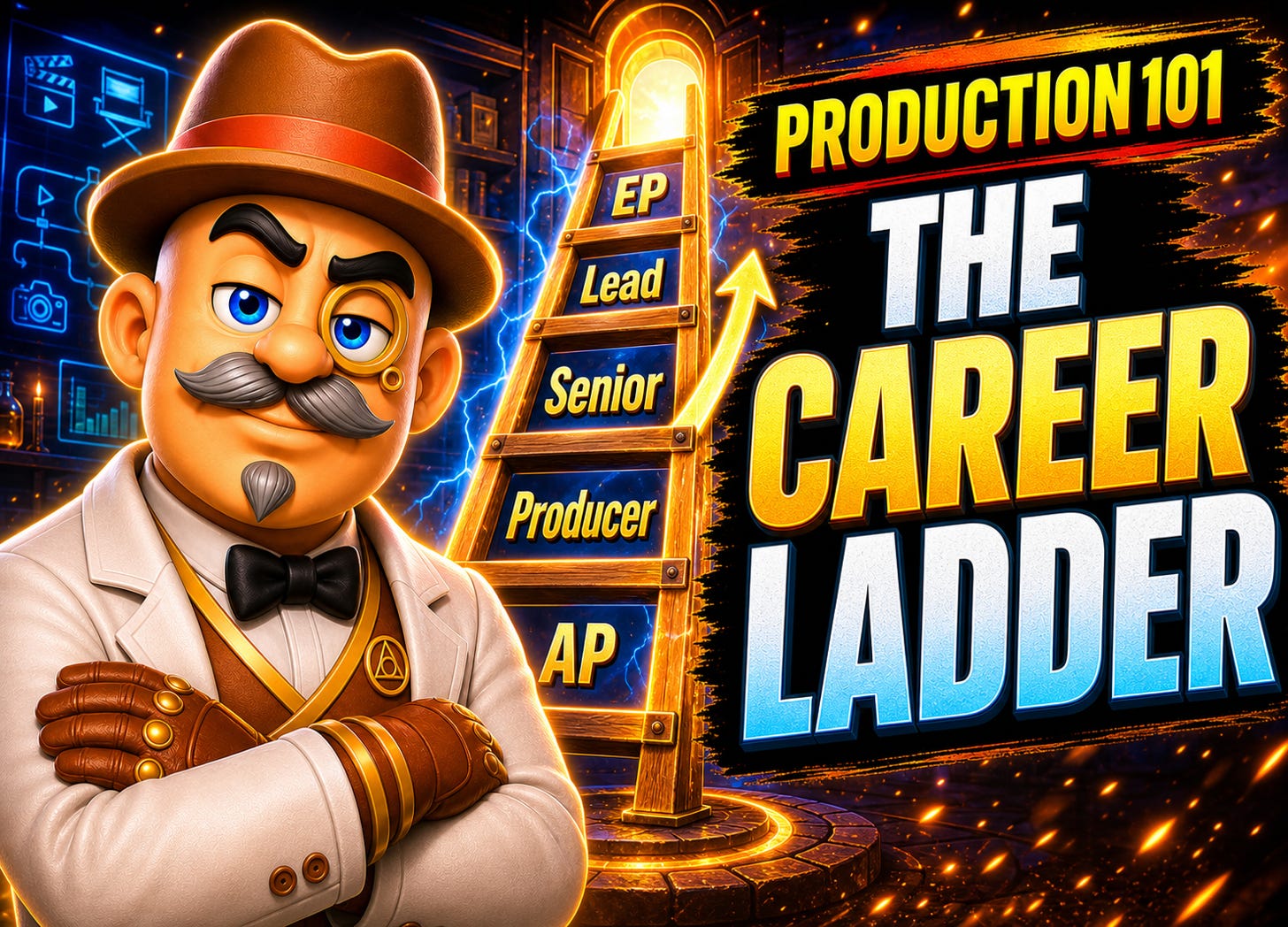
This is part of the Production 101 series. In the previous post I covered what a producer does in broad terms. This post gets more specific: the distinct roles that exist within a studio’s internal production team, what each one involves, and roughly what you need to qualify for each.
I’m going to be honest about the format here. These roles lend themselves to something close to a job description, and I’m going to lean into that rather than fight it. The goal is practical clarity, not literary prose.
If this is useful, there's more where it came from. Multiple free posts a week on game production, applied AI, leadership and how the sausage actually gets made.
What Every Producer Has in Common
Three things appear across all producer roles regardless of seniority.
The first is project management fluency. Every producer, from the most junior to the most senior, needs to understand how to plan, track, and adjust the work. That doesn’t mean everyone needs a certification. It means you can’t bluff your way through a schedule or pretend you don’t know what a dependency is. The specific methodology (Agile, Kanban, waterfall, some hybrid) varies by studio, but the underlying discipline doesn’t.
The second is knowledge of the game development process. Producers need to understand how games are actually made: how platforms work, what each phase of development looks like, where the risk lives at each stage. This isn’t optional. You’re the person accountable for the schedule, which means you need to understand what you’re scheduling. You’re also the person who flags risks early, and you can’t do that if you don’t know what normal looks like.
The third is leadership. Administration is part of it, but the core of it is this: the team looks to you when things get complicated, and your job is to give them clarity and direction. That’s true whether you’re an Associate Producer running a daily standup or an Executive Producer setting the studio’s strategy.
“Producers need to understand how games are actually made. You’re the person accountable for the schedule, which means you need to understand what you’re scheduling.”
1. Associate Producer
The Associate Producer is the entry point to production. The role is largely supportive: you’re working under a Producer, helping to keep the project’s logistics running. On a large project you might be the AP for a specific area of the game, for instance QA, a particular feature team, or a content pipeline. On a small project, you’re the Producer’s right hand across everything.
What you do: You run the regular ceremonies: daily standups, retrospectives, sprint planning. You own documentation, track progress against the plan, and flag anything that looks like it’s slipping. You support the design, development, and QA processes wherever the Producer needs cover. You also help maintain the team’s working environment, which sounds soft but matters more than people expect. A team that communicates badly or has accumulated unresolved friction is slower and less accurate. The AP is often the person who spots that early and does something about it.
What you need: Most studios want a relevant degree, in game design, communications, project management, or something adjacent, though many APs have come from elsewhere in development. QA is the most common pivot. You need strong organisational skills, the ability to communicate clearly in writing and in person, and genuine interest in the game development process. Prior experience in games is a plus at entry level; it becomes an expectation as you move up.
2. Producer
The Producer owns the project. Where the AP supports the work, the Producer leads it. Depending on the studio’s structure, a Producer typically focuses on one game or one platform, though in smaller studios the scope can be broader.
What you do: You manage scope, schedule, and budget. You work directly with designers, developers, artists, and whoever else is involved in making the game. You identify and manage risks, which in practice means you’re thinking two or three sprints ahead at all times, looking for things that could go wrong before they actually do. You also negotiate: resources, priorities, timelines. And you’re the primary conduit between the team and whoever they’re accountable to, whether that’s a publisher, a platform holder, or internal leadership.
What you need: Three to five years of experience in game production or a closely related field, with a record of successfully shipped projects. You need to understand methodology and tooling, not just in theory but in practice. The difference between a good AP and a ready-for-Producer is usually the ability to own a risk register and act on it without being prompted, and to make the call when two priorities genuinely conflict.
“The difference between a good AP and a ready-for-Producer is usually the ability to own a risk register and act on it without being prompted, and to make the call when two priorities genuinely conflict.”
Thirty-plus years of production work went into this. Most of it didn’t make the post. New posts every week. Free to read, free to subscribe.
3. Senior Producer
The Senior Producer brings both depth and breadth. They’ve shipped games. They’ve seen projects go sideways and brought them back. They’re not just leading a team; they’re mentoring the producers below them, and their scope typically covers multiple platforms, multiple teams, or in some studios, multiple projects running concurrently.
What you do: You lead and mentor cross-functional teams. You develop production strategies that fit both the project’s needs and the studio’s wider objectives. You manage large budgets and complex resource allocation, which means you’re constantly making trade-offs between quality, time, and cost. You manage stakeholder expectations at all levels, internally and externally. You’re also the person responsible for spotting risks before they become production problems, not after.
Industry trends matter at this level. You’re expected to know what’s happening in the industry and bring that knowledge to bear inside the studio, whether that’s a new tooling approach, a shift in platform requirements, or a change in how players expect to receive content.
What you need: Five to seven years at a senior level in game production, with a record of delivering high-quality and commercially successful games. You need strong mentorship skills, because part of your job is developing the producers below you. You also need to be comfortable operating at the strategic level, not just the tactical one.
4. Lead Producer
The Lead Producer sits above individual projects. Where the Senior Producer is typically accountable for a specific project or set of projects, the Lead Producer oversees the production department as a whole. They set the strategic direction for how the studio produces games, not just for one team but for all of them.
What you do: You manage the entire production function, across multiple projects running simultaneously. You develop the studio’s production strategy, working closely with executive leadership to make sure production objectives match the business’s direction. You’re involved in recruiting, because building the right production team is part of your remit. You mentor and develop Senior Producers. And you’re responsible for the studio’s overall production health: its ability to ship consistently, on time, and to a standard.
What you need: Eight to ten years in leadership roles within game production, with a record of successfully delivering complex, multi-project portfolios. You need strong strategic thinking. You need to be effective at the relationship layer: with internal teams, with external partners, with stakeholders at every level. And you need to be able to make decisions at scale, where the right call for one project might create friction for another.
“The Lead Producer is accountable for the studio’s overall production health: its ability to ship consistently, on time, and to a standard.”
5. Executive Producer
The Executive Producer is the most senior production role in the studio. The scope is the studio’s entire portfolio and its creative and strategic direction. This is the person setting the agenda for what gets made, how it gets made, and whether the studio is positioned to keep making things at that level.
What you do: You define the studio’s development vision and make sure it matches the business goals and what the market needs. You oversee every project in the portfolio, ensuring they’re on time, within budget, and meeting the quality bar. You lead, mentor, and develop the production team at every level below you. You build and maintain the key relationships: publishers, platform holders, the player community. You own the studio’s financial planning, budget allocation, and resource management across all projects. And you’re the studio’s representative externally, at industry events, in the press, with partners.
What you need: Ten or more years in game development, with a significant portion in leadership roles covering multiple projects or large multidisciplinary teams. A record of leading games from development through to commercial and critical success. Strong business acumen, because at this level production and business strategy are the same thing. Exceptional communication and negotiation skills. And, genuinely, a commitment to staying current with where the industry and the technology are going. Studios that don’t keep up with platform shifts, player behaviour changes, and technology developments get left behind.
The One Rule Nobody Writes Down
One thing that doesn’t appear in any formal job description but is, in my view, non-negotiable for any producer at any level: you must play your game.
Regularly. Throughout production, from the earliest prototype through to live operations. You need to know what the game actually feels like to play, not just what the feature list says it’s supposed to do. You need to have an opinion about it.
Even when the game is still a concept, a storyboard, a spreadsheet of proposed mechanics, imagine playing it. Think about what it would feel like. Ask the team how they’d describe the experience to someone who’d never heard of it. The producer who can only describe a game in terms of its deliverables and milestones is a project manager. The producer who also understands what the game is, and whether it’s working, is something more useful.
This series continues in Production 101 #3: Role of an Internal Producer, which goes deeper on what internal producers specifically do and how they differ from external producers.
Production 101

Welcome to the Production 101 series, where we dive deep into game production. This series is about uncovering this professional discipline's mysteries, providing a platform for newcomers and seasoned professionals.
If this changed how you think about even one thing, the next post might too.