

Harvard Business Review Just Invented the Producer
How the most-starred AI game dev framework on GitHub accidentally ran a study in producer cognition

Claude Code Game Studios hit 19,380 GitHub stars in three months with no shipped game, and its most-engaged thread is a question about why the AI won’t build anything without human direction
The users who fail treat it like autopilot; the users who succeed treat it like a studio that needs a managing director
In February 2026, Harvard Business Review published a new role to describe what producers have been doing for thirty years
Producer cognition is a specific set of moves, not instinct, and you can watch them fail in real time across three languages on a GitHub issue page
In February 2026, an open-source framework launched on GitHub with a clear pitch: turn a single Claude Code session into a full game development studio. By May, Claude Code Game Studios had 19,380 stars, 2,828 forks, and no shipped games. Its most active issue is a question: why does the AI generate elaborate design documents and sprint plans while producing almost no playable code?
The answer sitting in that thread, in English, Chinese, and Russian, is the same one game studios spent decades learning. The studio doesn’t run itself. You do.
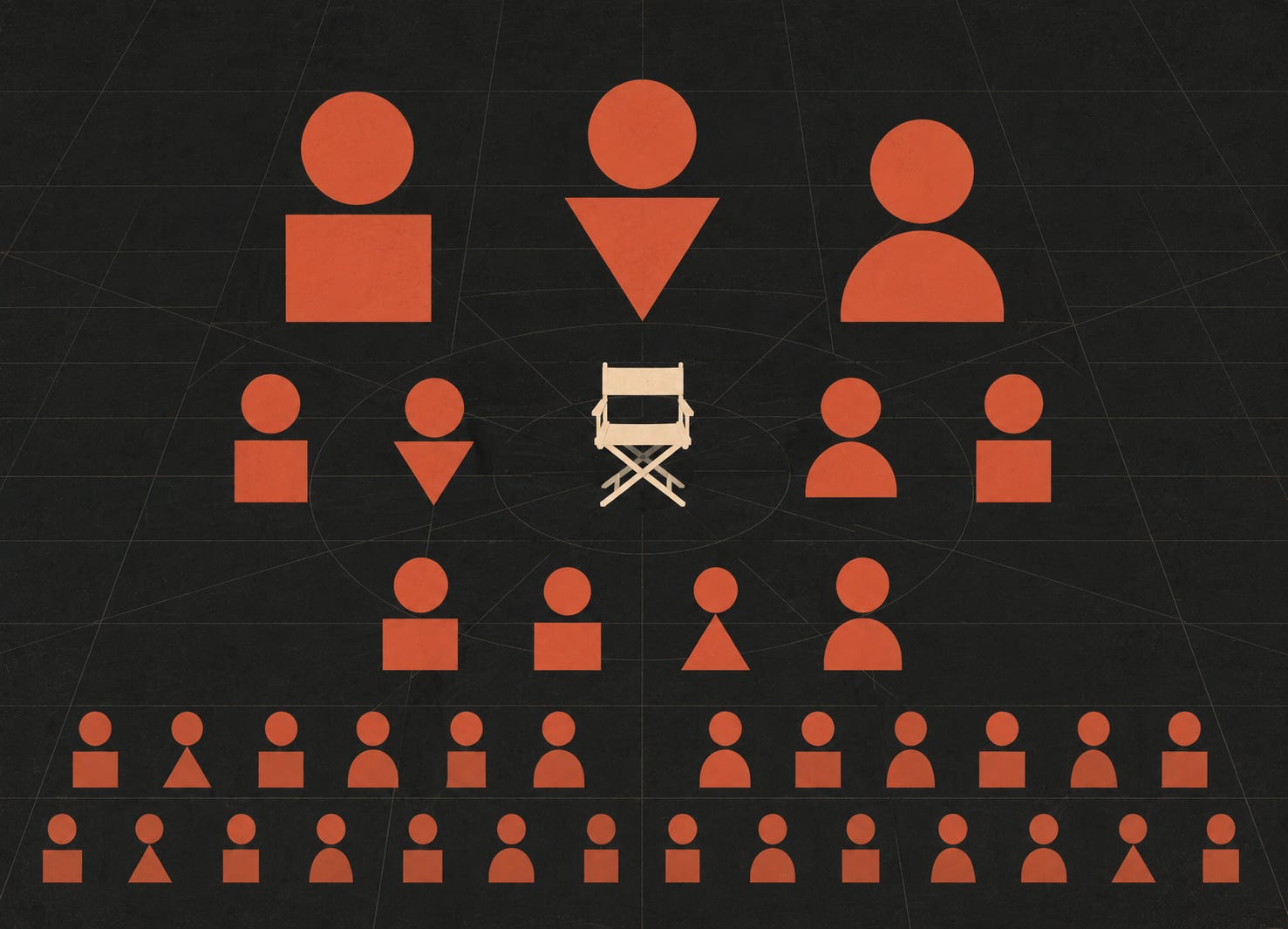
CCGS is a 49-agent framework built around a studio hierarchy: Tier 1 Directors, Tier 2 Department Leads, Tier 3 Specialists. It ships with 73 slash command skills, 12 automation hooks, and 41 document templates. The workflow runs from concept through game pillars, game design documents, architecture decision records, epics, user stories, and sprint planning before the agents touch code. That sequence exists for good reasons. It also means that for users expecting to describe a game and receive one, the first week is friction and consumed tokens producing nothing playable.
The expectation gap
csn6666, posting in Issue #46: “I feel like there are too many documents and communications between agents and humans but nothing’s really built after burning 30% of my weekly quota.”
LeonPang, writing in Chinese in Issue #29: “I thought I’d pitch an idea and the AI would run with it. Instead it turned into me doing the designing and the AI reviewing me.”
These are honest accounts of a genuine mismatch. The framework produces exactly what it’s designed to produce: structured pre-production artefacts, gated by a human decision-maker at each stage. The gap is between the README’s implied promise and what the work demands from the person sitting with it.
The documents are the first deliverable of a studio with an absent director. The quota was spent correctly. The director wasn’t there to use them.
The Chinese-language threads mirror the English ones almost exactly. So do the Russian threads. When the same complaint surfaces in three languages on the same framework, the problem is structural. The friction is baked into the design assumptions. Those assumptions include a human who knows what to do with pre-production artefacts.
The README doesn’t mention that.
What the users who succeed are doing
A user named elysi is 19 days into their current run. They have 188 GDScript files, 1,081 tests running via Godot Unit Testing at each code iteration, and a semi-playable pre-MVP baseline in Godot. They hit 100% of their weekly token limit by day 6 every week. They also trimmed CCGS to 49% of its original size after one restart, wrote 15 custom bash helper scripts to manage context consumption, and capped their deferred items register at 50, running a mid-sprint polish pass at 40 open items.
Their summary of what makes CCGS work: “The key to CCGS is the ‘studio’ doesn’t build the game. You’re the managing director. You need to steer it.”
That sounds obvious until you look at what steering requires. Producers do three specific things before they do anything else.
The first is reading the room. elysi’s restart decision didn’t come from the framework flagging a problem. It came from noticing that agents were arguing, tech-debt was accumulating faster than it was resolving, and the system was drifting. Reading the room means recognising the state of a system before acting on it. The users who struggle are prompting into a degrading environment and expecting different results.
The second is active listening. There’s a difference between reading agent output for confirmation and reading it for signal. Agents drift. They develop inconsistencies. Issue #63 documents this precisely: the /dev-story skill re-reads full architecture decision records even when stories already contain embedded summaries designed to prevent exactly that duplication. An agent won’t flag this. You have to notice it. Active listening is the practice of reading outputs for what they reveal about system health, not just for whether they completed the task.
The third is sentiment in the artefacts. Before elysi’s restart, they didn’t check headline metrics. They went into the state of the repo: the comments in deferred items, the tech-debt register, the patterns in what was escalating. That’s the Jira and Confluence read a producer does on day one of a troubled project. Before meetings. Before conversations. The information is in the margins.
“The key to CCGS is the ‘studio’ doesn’t build the game. You’re the managing director. You need to steer it.” — elysi, GitHub Issue #46
Technical skill accounts for little of the difference between elysi and the frustrated users in the same thread. smithjoshua125-rgb describes themselves as a complete novice and emerged from less than one week with a working prototype: a movement system, rollback netplay with client-side physics, and predictive replay working reliably at 100ms of simulated latency. They estimated the same work would have taken four to six months to learn and build manually. The difference: they treated CCGS as a framework to direct, not an autonomous builder to instruct. They went in knowing they were the director.
The CCGS community is discovering producer behaviours from first principles, without any production-methodology vocabulary. They aren’t talking about flow metrics or WIP limits. They’re working it out in GitHub threads because the work demanded it.
woobenny08, in the same Chinese-language thread as LeonPang: “Without the cognitive mindset of a ‘producer,’ AI simply cannot help you make a competent game.”
That observation was posted on a game framework’s GitHub issues page, in Chinese. It is also the most precise summary I’ve read of the research literature on AI agent management from the last six months.
HBR named the role in February
On February 12, 2026, Harvard Business Review published “To Thrive in the AI Era, Companies Need Agent Managers,” by Suraj Srinivasan and Vivienne Wei. The article introduces a new organisational role for overseeing AI agents: someone responsible for orchestrating how agents learn, collaborate, perform, and work safely alongside humans. They frame it as the role product managers played during the software revolution.
The strongest candidates, they argue, are people from operations and project management backgrounds. People who already understand the business process being automated deeply enough to evaluate whether an agent is executing it correctly.
They did not use the word “producer.” But the cognitive profile they describe is one game producers would recognise from their second week in the role.
The Salesforce agent manager they profile describes his daily routine as “Data, data, data. I start and end my day in dashboards, scorecards, and agent observability monitoring.” That is what a LiveOps producer’s Monday morning looks like, transposed to an enterprise AI context.
Srinivasan and Wei identify six competencies for the agent manager role. Three of them map directly onto what I described above. Understanding how agents function and how to diagnose failures. Knowing the domain process deeply enough to evaluate outputs. Defining when agents act alone and when they escalate to a human. These are reading the room, active listening, and sentiment in the artefacts. HBR named them for an audience that hadn’t encountered them before.
The broader data is consistent. Deloitte’s 2026 State of AI in the Enterprise report identifies the AI skills gap as the biggest barrier to integration and finds that only one in five companies has mature governance of autonomous AI agents. RAND Corporation’s 2025 analysis found 80.3% of AI projects fail to deliver intended business value. The Connext Global 2026 AI Oversight Report found only 17% of US adults consider workplace AI reliable without human oversight. A Workday analysis from January found roughly 40% of apparent AI productivity gains were being lost to rework and low-quality output. Every one of these reports describes the absence of producer work, in different vocabulary.
The game industry ran its own version of this study in 2025 through the “gameslop” wave: AI-assembled titles with no human curation that flooded storefronts and damaged player trust. The GDC 2026 State of the Game Industry report shows 52% of game professionals now view generative AI negatively, up from 30% the year before. The technical capability arrived faster than the understanding of how to direct it. That’s a different way of measuring the same skills gap Deloitte is tracking, and the same underlying problem.
The structural point
CCGS is generating honest production data in public, across three languages, about what agentic development actually costs and what it actually requires. The 19,000 stars reflect real interest from developers who want to build games with AI agents. Some of them are succeeding.
But the thing the community keeps discovering, at every experience level and in every language, is the same gap. The framework tells you what the agents can do. It tells you very little about what you need to bring to it.
What you need to bring is the ability to read a system that is drifting, to hear what the agents are actually producing rather than what you asked them to produce, and to go into the artefacts for the signal that doesn’t make it into the summary reports. That combination of skills has a name. It has had one for thirty years. The CCGS community didn’t coin it. They just ran into it without warning.
HBR called this “agent management” in February. The CCGS community discovered it in May. Game studios have been hiring for it since before GitHub existed.
All three are describing the same gap.
“Without the cognitive mindset of a ‘producer,’ AI simply cannot help you make a competent game.” — woobenny08, GitHub Issue #29