


Why “was AI involved” fails as a disclosure question and what replaces it
The five-layer AI stack quietly measures two different things at once
Provenance and licensing sit across every layer, not inside one
The labour cost of AI hides in the exact tier the framework tells you to ignore


Josh English wrote the best thing I have read on AI in games, and I want to argue with it.
His piece, “’Was AI Involved?’ is the Wrong Question for Games,” makes a case I have been trying to make in the C-suite for two years and doing worse. The blunt question, did AI touch this game, sweeps a code assistant fixing a build script into the same bucket as a store page full of generated portraits, and once everything is in one bucket the bucket tells you nothing. His fix is a vocabulary. He lays out five layers, from ambient AI in the background of the toolchain, through disposable internal drafts, through shipped generated content, through runtime systems, up to games built around AI as a design pillar. Each layer carries a different creative burden, a different legal exposure, a different obligation to the player. The right question, he says, is not whether AI was involved but how.
If this is useful, there's more where it came from. Multiple free posts a week on game production, applied AI, leadership and how the sausage actually gets made.
He is right. I have shipped work using cruder frameworks than his, and I would use his tomorrow. So this is not a takedown. It is the thing you do to a good framework, which is push on it until you find where it bends.
It bends in one specific place, and the place tells you something.
He wrote the list himself
Before English builds anything, he tells you what a good framework would have to hold. A single label, he says, cannot responsibly cover all of the following: production tooling, internal drafts, shipped assets, runtime behaviour, legal provenance, labour substitution, creative authorship, player data, and design intent.
Nine things. Now count the rungs he builds.
Ambient AI is production tooling. Internal drafts is internal drafts. Shipped content is shipped assets. Runtime AI is runtime behaviour. The fifth, AI as a design pillar, takes creative authorship and design intent together.
Five rungs. Nine items. Legal provenance, labour substitution, and player data get no rung at all.
I think this is what happens when you build a framework around one question, in this case what a player is owed, and then find it will not hold the things that never reach the player. The list is the honest inventory. The ladder is what survived the design.
This piece finishes his list.
Two rulers, one label
Start with the five that did make it, because even those measure two different things.
The layers look like a ladder. English calls ambient the lowest layer and design pillar the highest category, and everything else ranks in between by how seriously you should take it. Read them again and the ladder comes apart in your hands, because the bottom three rungs and the top two are measuring different things.
Ambient AI, internal drafts, shipped content. Those three answer one question: where does AI sit in the production pipeline. Background, upstream, or in the box the player buys. That is a location.
Runtime AI, AI as a design pillar. Those two answer a different question: how much does AI determine what the player actually experiences. A live model generating dialogue is not further along the same line as a shipped texture. It is on a different line. “Design pillar” is not a place in the pipeline at all. It is a statement about ambition, about whether intelligence is the point of the game or a way of making the game.
You cannot rank a location and an intensity on the same axis. Try it and you get the exact ambiguity English spends the piece trying to escape. Is a game with one AI-voiced side character “runtime AI” or “shipped content”? Both. Is a procedural quest system a design pillar or a production shortcut? Depends entirely on how much of the game leans on it, which is a question his ladder has no rung for.
A single label cannot hold the disagreement. Neither can a single axis. A ladder with two different rulers welded end to end is still a slogan, just a longer one.
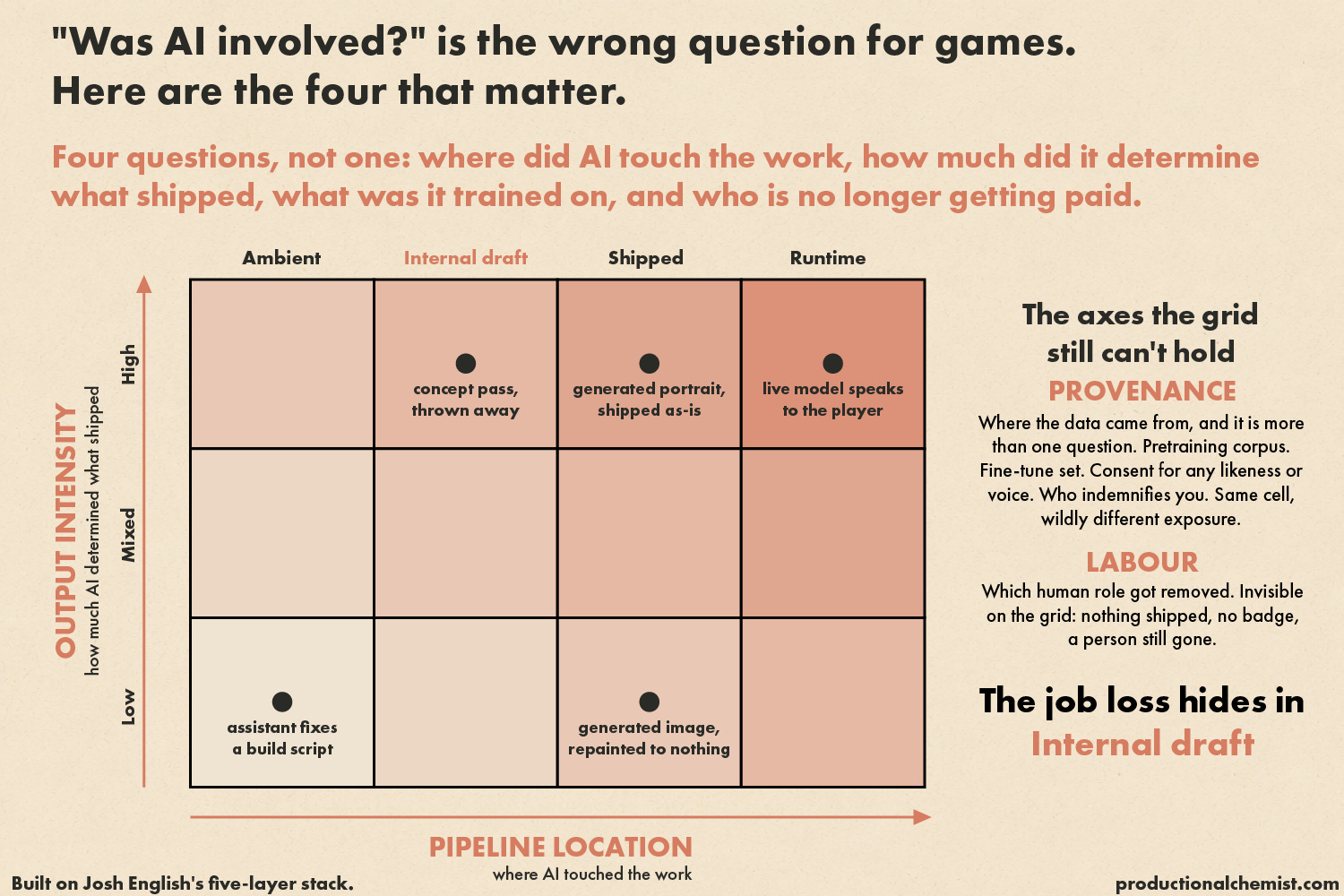
Split them and the framework stops fighting itself. One axis for pipeline location: where did AI touch the work. A second axis for output intensity: how much did AI determine what shipped. Now you have a grid, and the grid has cells the ladder could not name. A generated image repainted so heavily that nothing of the original survives sits in one cell. A generated image shipped with a colour tweak sits three cells away. English names both of those cases and then cannot place them, because on a single line they look adjacent. On a grid they are nowhere near each other, which is the truth.
The messy middle he keeps gesturing at is not messy. It is two-dimensional, and he was trying to read it with a ruler.
The axis he keeps rediscovering
Watch what English does across the piece with the question of where a model came from.
In the shipped-content section: a licensed commercial model trained on cleared data is not the same as an unknown tool with murky provenance. In the same section: a vendor asset under contract is not the same as a marketplace pack nobody verified. In the artist section: model training and consent are real questions that deserve direct discussion. Three times he raises the origin of the model, and three times he raises it as an aside inside a layer that is really about something else.
Once, at the top of the piece, he raises it properly. Legal provenance is item five on his own list of what a label cannot hold. It spends the rest of the essay as a footnote to other people's tiers.
When a thing keeps surfacing in every section as a side note, it is not a side note. It is a dimension you have not drawn yet.
Provenance cuts across every layer he has. Same pipeline location, same output intensity, wildly different exposure depending on whether the training data was licensed, whether the vendor indemnifies you, whether the actor consented. Two studios can ship the identical generated portrait at the identical level of human editing. One licensed a model trained on cleared data with a contract behind it. The other pulled a marketplace pack of unknown origin. English’s framework files those two acts in the same cell. A court would not.
There is a fair objection to compressing this into one question, and Edvard Toth made it to me directly, with English agreeing. Most training data is scaffolding, the statistical substrate that lets a model generalise at all, and it rarely surfaces in any particular output. The specific dataset, the fine-tune, the reference image handed to the model at generation time, sits much closer to the work. Asking what a model was trained on flattens those together.
They are right, and it is the charge I have just laid against the ladder. One question doing several jobs.
So the axis has four fields. The pretraining corpus. The fine-tune or reference set. Consent, where a likeness or a voice is involved. Indemnity, which decides who absorbs the loss. A model can be clean on the first and catastrophic on the third.
What survives the objection is the part a producer needs. Scaffolding describes how a model generalises. Licensing describes how the data was obtained. Those are separate questions, and the second does not dissolve because the first is interesting. Every image in that substrate was acquired from somewhere. A court will not ask whether a JPEG contributed to abstract capability or to the final render, and neither will an actor whose voice was cloned.
Steam has already run into this wall in public. Valve’s January 2026 rewrite split efficiency tools from shipped content, which is English’s distinction almost exactly, and it works. But Valve publishes no threshold for how much human editing removes the disclosure obligation, and it will not rule on where your training data came from. Their own guidance lands on: keep the original output, keep your revision history, and if generated material is still recognisable in the final product, disclose. That is an honest admission that the platform can see pipeline location and can roughly see intensity, and cannot see provenance at all. It has outsourced the axis it cannot measure back to the developer.
The market is pricing that missing axis whether or not anyone charts it. Research from Ross Burton at Game Oracle found games carrying an AI disclosure drew around 53% fewer reviews than games without one, and almost a fifth got no reviews at all. Players cannot see your licensing paperwork. They see the badge, they assume the worst provenance, and they price it in. The absence of a provenance axis does not make provenance stop mattering. It just means everyone guesses, and the guess runs against you.
The axis the ladder is built to hide
Here is the place the framework bends hardest, and the bend is structural. It follows from what the framework was built to measure.
English sorts the disposable material into its own layer: mood boards, rough concepts, graybox levels, placeholder dialogue, test audio, pitch images, the exploratory work that helps the team think and never reaches the player. He is careful about it. He says the tier still matters, that studios should care about vendor terms, licensing, provenance and contractor policy, and that “only for reference” is not a magic spell. He is right about all of it. EU Artificial Intelligence Act
Read the risks he names in that tier again. Vendor terms. Licensing. Provenance. Contractor policy. Every one of them is a risk to the studio. Not one of them is a risk to a person.
Labour substitution was item six on his list. It never appears in the tier where labour substitution happens.
Job loss does not happen when the asset ships. It happens when the role gets automated. And the roles get automated upstream, in precisely the tier English marks as not the player’s business: the concept pass, the placeholder, the first-draft asset, the graybox. A framework that tracks only what reaches the player cannot see labour substitution by construction, because labour substitution is invisible on the pipeline axis. Nothing shipped. No badge required. A person is still gone.
He named labour substitution in the sentence that set up the whole framework. Then he built five rungs and gave it none.
The data is not subtle about who is standing there. Read against the GDC State of the Game Industry survey, artists are the group most opposed to generative AI, 64% viewing it negatively, with designers close behind at 63%. Visual arts also sat among the hardest-hit departments in the layoffs of the last two years, with 16% of survey respondents in the field reporting cuts. Analysis of the layoff patterns finds junior staff targeted in greater numbers than senior, and the entry-level work now handed to AI, early-stage art, QA, basic programming, is exactly the foundational work people used to climb through to build expertise. Senior talent keeps its value because it can direct the model. The junior who would have become that senior never gets the reps. You automate the bottom of the ladder and then wonder, in five years, why there is nobody halfway up it.
Thirty-plus years of production work went into this. Most of it didn’t make the post. New posts every week. Free to read, free to subscribe.
None of this shows up if the only question you ask is what the player experiences. English’s framework asks a genuinely better question than “was AI involved.” It still asks the player’s question. The worker’s question runs on a different axis, and a framework built around disclosure to a buyer has no reason to draw that axis. This is not a charge against English. It is the natural blind spot of any model organised around what reaches the player: labour substitution is the one cost that leaves no trace in the finished product. The honest move is to add the axis, not to pretend the ladder already covered it.
Why this is a producer’s problem, not a critic’s
I am not writing this to win a discourse point. I run production, and the grid matters to me because I cannot manage a risk I have collapsed into a slogan. Each axis is a different column in the register, and the columns do not trade off against each other. They accumulate.
Two of them English already handed me. Pipeline location is my disclosure exposure: where AI touched the work decides what I owe a platform, and getting it wrong delays a store page or invites a pile-on. Output intensity is my creative defensibility: how much a model drove the result decides whether I can stand behind the work as authored, or whether I have shipped a heap of generated output with no point of view, which players smell in a trailer and reviewers punish in week one.
The two the ladder cannot hold are the two that keep me up. Provenance is my legal exposure, and it runs on a delay timer. Where the model was pretrained, what it was fine-tuned on, whether the vendor indemnifies me, whether the actor consented, none of it shows in the shipped asset and all of it shows in discovery. And labour is the slow one, the cost that arrives years after the saving. Automate the concept pass and the graybox and the first-draft asset and you bank the money this quarter. You pay it back when the junior who would have learned the craft on that work was never hired, and the senior who could have trained them is directing a model instead. A studio can look efficient and be quietly eating its own future, and no disclosure form will ever flag it.
Four columns. The single label holds none of them. English’s ladder holds two and reaches for the third. Draw provenance and labour as their own axes and you have a register a producer can actually run, in place of a purity test a mob can run at you.
English says the industry needs a vocabulary instead of a purity test, and he is right. A vocabulary with one axis is a purity test with better manners.
So yes, AI was probably involved. The better question is how, and the producer’s version of how is four questions wearing a coat: where did it touch the work, how much did it determine what shipped, what was it trained on, and who is no longer getting paid. Answer all four and you have said something true. Answer only the first and you have swapped a blunt instrument for a quieter one.
Correction, 9-Jul. An earlier version of this piece attributed to Josh English a verdict on internal drafts that he did not make. His remark about not burdening the buyer with production detail refers to ambient tooling, such as build scripts and bug reports, and not to concept work. English says the internal-drafts tier still carries licensing, provenance and contractor-policy risk, and that calling something reference-only settles nothing. The argument here has been revised, and I think it is stronger for it: he names labour substitution himself, in the sentence that introduces his framework, then gives it no rung on the ladder.
The provenance section has also been extended, following a public exchange with Edvard Toth and Josh English about what "trained on" actually asks.
If this changed how you think about even one thing, the next post might too.